


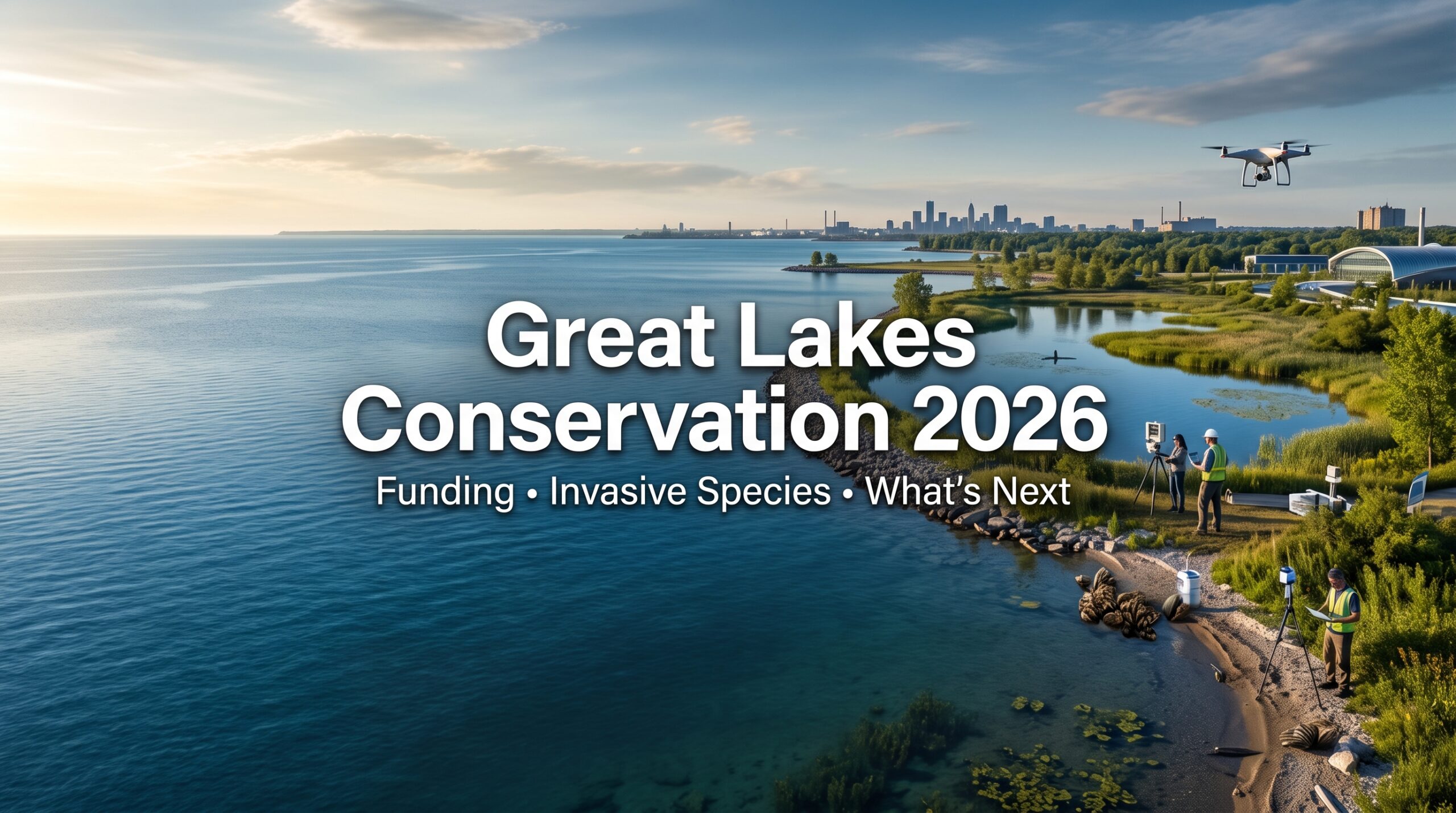
From a $72M invasive carp defense to bipartisan restoration funding, here’s a complete guide to Great Lakes conservation efforts in 2026 and how communities, businesses, and policymakers can get involved.
Key Takeaways
- The Great Lakes hold more than 20% of the earth’s surface fresh water and 10,000 miles of shoreline, providing drinking water for tens of millions of people across eight U.S. states and two Canadian provinces.
- More than $72 million has been dedicated to 45 priority projects in 2026 to protect the lakes from invasive carp, combining $51.4 million in agency appropriations with $21 million in Great Lakes Restoration Initiative (GLRI) funding.
- The Sustain Our Great Lakes program awarded $8.8 million in new grants in April 2026, leveraging an additional $11.7 million in matching funds for a total conservation impact of $20.5 million this cycle alone.
- Congress rejected steep proposed cuts to Great Lakes funding programs in its recent budget package, preserving core federal support despite White House proposals to slash it.
- More than 180 non-native species are already established in the Great Lakes basin, with invasive carp, zebra mussels, sea lamprey, and Phragmites (an invasive reed) representing the most active and heavily funded threats.
Why the Great Lakes Matter: A Resource Under Pressure
The Great Lakes represent one of the most significant freshwater ecosystems on Earth — holding more than 20% of the planet’s surface fresh water, spanning 10,000 miles of shoreline, and encompassing 30,000 islands. Beyond their ecological significance, the lakes provide drinking water for tens of millions of people and support a commercial and recreational fishery valued at almost $5.1 billion annually.
Despite this scale and value, the region has been significantly degraded over the past two centuries by habitat loss, fragmentation, invasive species, and pollution — threats that continue to require sustained, coordinated funding and policy attention in 2026.
The 2026 Invasive Carp Defense: A $72 Million Commitment
The single largest coordinated conservation action of 2026 centers on invasive carp — a catch-all term for four destructive species (silver, bighead, grass, and black carp) that threaten to disrupt the Great Lakes’ food web if they become established.
Funding Breakdown
- Total investment: More than $72 million across 45 priority projects
- Funding sources: $51.4 million in direct agency appropriations, supplemented by $21 million in Great Lakes Restoration Initiative funding
- Coordinating body: The 26-member Invasive Carp Regional Coordinating Committee (ICRCC), a partnership of federal and state agencies
- Economic stakes: Protecting a fishery valued at nearly $5.1 billion annually
Where the Money Is Going
Beyond broad monitoring and barrier infrastructure, specific 2026 initiatives include:
- Continued work with commercial fishers to gather black carp specimens for scientific research
- Modified sampling approaches targeting black carp specifically in the lower Illinois River, applying lessons learned from Mississippi River monitoring
- Heightened attention to black carp’s diet of mussels and snails, since many native freshwater mussel species are already imperiled and would face compounding pressure from an established black carp population
The Sustain Our Great Lakes Program: Two Decades of Habitat Restoration
Separate from the carp-specific initiative, the Sustain Our Great Lakes (SOGL) program — a public-private partnership between the National Fish and Wildlife Foundation (NFWF) and the Great Lakes Restoration Initiative, alongside corporate partners including Cleveland-Cliffs and General Mills — represents one of the region’s longest-running restoration funding mechanisms.
2026 Grant Cycle
- $8.8 million in new grants announced in April 2026
- $11.7 million in matching contributions leveraged from grant recipients
- $20.5 million total conservation impact for this cycle
- 26 grants distributed across Illinois, Indiana, Michigan, Minnesota, New York, Ohio, and Wisconsin
Cumulative Program Impact (2006–2025)
Since its founding, the SOGL program has awarded a cumulative $151.2 million across 555 grants, with grantee matching funds bringing total on-the-ground conservation impact to more than $343.8 million. Documented outcomes include:
- 2,828 miles of stream reconnected for fish passage and access
- 60,990 acres of wetland and associated upland habitat restored
- 401 million gallons of stormwater storage capacity added
Federal Policy Landscape: Funding Survived Proposed Cuts
A significant policy development in 2026 involved federal budget negotiations directly affecting Great Lakes program funding. The White House had proposed steep cuts to programs supporting Great Lakes restoration; however, Congress ultimately rejected these proposed reductions in its recent budget package, preserving funding levels for programs that communities and ecosystems throughout the basin depend on.
Separately, a bipartisan bill co-sponsored by Sens. Gary Peters and Elissa Slotkin to extend Great Lakes funding has advanced in the Senate, backed by a broad coalition including American Rivers, Ducks Unlimited, Trout Unlimited, the National Audubon Society’s Great Lakes program, and the Congressional Sportsmen’s Foundation. This legislative effort builds on what supporters describe as the single-largest-ever investment in the Great Lakes Restoration Initiative, enacted previously through bipartisan infrastructure legislation.
The Great Lakes Commission’s 2026 Policy Priorities
The Great Lakes Commission — a binational agency representing all eight U.S. states and two Canadian provinces in the basin — has outlined its 2026 congressional priorities, urging lawmakers to:
- Pass a new Farm Bill with Great Lakes-relevant conservation provisions
- Reduce the impact of harmful algal blooms
- Prevent further damage from aquatic invasive species
- Contribute to overall basin resilience amid climate and development pressures
Invasive Species: The Persistent, Multi-Front Threat
Beyond carp specifically, the Great Lakes face an established invasive species crisis, with more than 180 non-native species already present in the basin. Key ongoing management efforts include:
- Sea lamprey control, targeting a species that devastates prized native fisheries
- Zebra mussel management, addressing a species that encrusts underwater infrastructure and disrupts native ecosystems
- Phragmites (common reed) treatment, supported by more than $500,000 in GLRI funding distributed through the Great Lakes Commission’s Phragmites Adaptive Management Framework, helping local organizations control one of the basin’s most aggressive invasive plants
- The Aquatic Invasive Species Landing Blitz, an annual, multi-state and provincial public awareness and enforcement initiative now in its eighth year
How Communities, Businesses, and Individuals Can Get Involved
For Local Organizations and Municipalities
- Sustain Our Great Lakes grant applications remain open on a competitive basis — organizations working on habitat restoration, water quality improvement, or invasive species control in Illinois, Indiana, Michigan, Minnesota, New York, Ohio, or Wisconsin should monitor upcoming request-for-proposal cycles.
- NOAA Great Lakes Fish Habitat Restoration Partnership Grants remain available on an annual basis, with 2026-cycle applications for federal fiscal year 2027 funding due by September 4, 2026.
For Businesses and Corporate Partners
- Corporate conservation partnerships, following the model established by Cleveland-Cliffs and General Mills within the SOGL program, offer a structured pathway for businesses with Great Lakes basin operations to contribute matching funds toward habitat and water quality projects.
For Individuals and Recreational Users
- Boaters and anglers play a frontline role in preventing invasive species spread — following “clean, drain, dry” protocols between waterways remains one of the most effective individual-level interventions against species like zebra mussels and invasive plants.
- Advocacy engagement with congressional representatives regarding Great Lakes Restoration Initiative funding levels can directly influence future appropriations, particularly given the active bipartisan legislative efforts currently underway.
Actionable Takeaways
- Track the Peters-Slotkin bipartisan Great Lakes funding extension bill as it moves through the Senate — its outcome will shape multi-year funding certainty for the entire basin’s restoration ecosystem.
- Organizations seeking funding should evaluate eligibility for Sustain Our Great Lakes grants and NOAA’s Fish Habitat Restoration Partnership Grants, noting relevant application deadlines.
- Businesses operating in the basin should consider formal conservation partnerships as both a compliance-adjacent risk management strategy and a community engagement opportunity.
- Recreational water users should adopt invasive-species prevention protocols consistently, given how directly individual behavior affects the spread of high-cost threats like invasive carp and zebra mussels.
Frequently Asked Questions
How much funding is being spent on Great Lakes invasive carp protection in 2026? More than $72 million has been dedicated to 45 priority projects in 2026 to protect the Great Lakes from invasive carp, combining $51.4 million in direct agency appropriations with $21 million in Great Lakes Restoration Initiative funding, coordinated through the 26-member Invasive Carp Regional Coordinating Committee.
What is the Sustain Our Great Lakes program? Sustain Our Great Lakes is a public-private partnership between the National Fish and Wildlife Foundation and the Great Lakes Restoration Initiative that awards grants for habitat restoration and water quality improvement across the Great Lakes basin, having distributed over $151 million across 555 grants since 2006.
Did Congress cut funding for Great Lakes conservation programs in 2026? No — Congress rejected steep cuts to Great Lakes restoration funding that had been proposed by the White House in its recent budget package, and a separate bipartisan bill to extend Great Lakes funding has since advanced in the Senate.


