


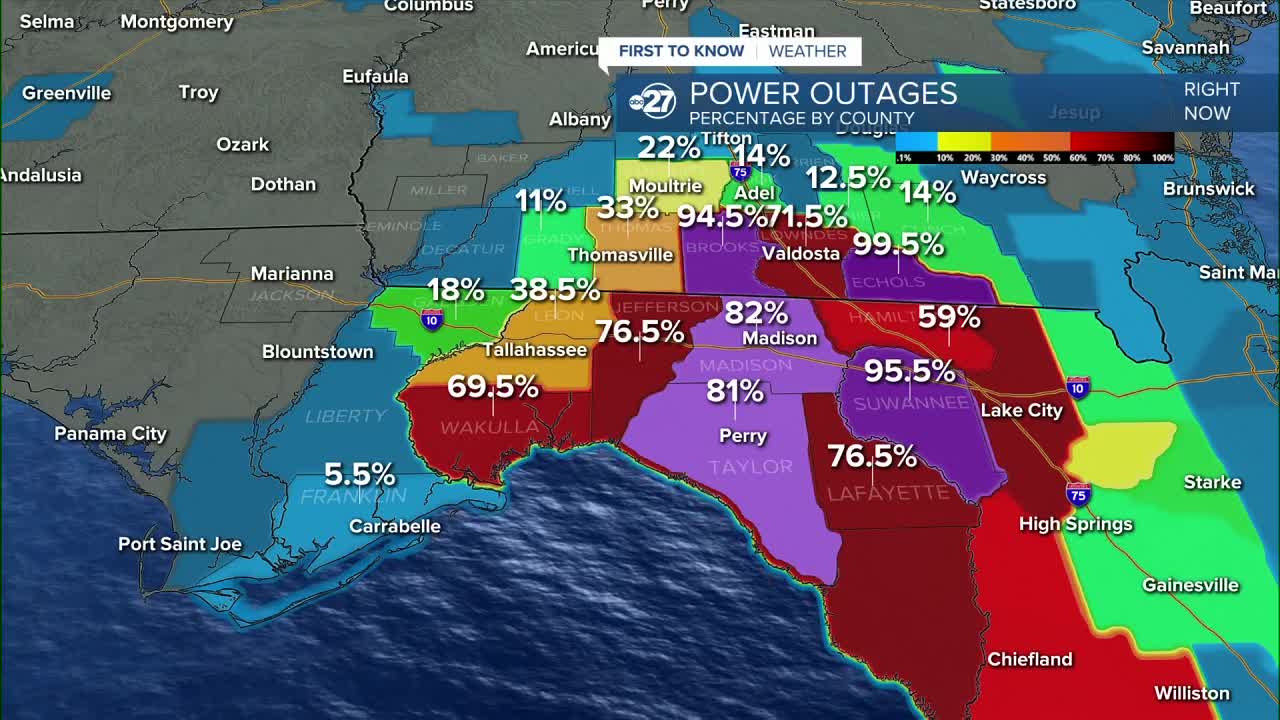
Hurricane Isaias left hundreds of thousands of electricity customers without power across Florida and neighboring states as it struck the northern Gulf Coast on October 9, 2026. The Florida Panhandle experienced damaging winds, downed trees, blocked roads and flooding. By early Saturday, the National Hurricane Center classified Isaias as a post-tropical cyclone over Alabama, but warned that flash-flooding risks continued. Residents looking for reliable restoration information should use their specific electric utility’s outage map rather than an old statewide screenshot. National Hurricane Center advisory, Reuters storm coverage and the live Florida outage aggregation page give different but complementary information.
Key takeaways:
- Isaias caused widespread disruptions on October 9–10, especially in the Florida Panhandle and adjacent areas.
- Outage totals change rapidly and measure customer accounts, not necessarily individual people.
- Official utility maps are the best place to report a home outage and check estimated restoration when available.
- Floodwater, fallen lines and improperly used portable generators can remain dangerous even after the storm weakens.
Where are Florida power outages being reported?
Outage aggregator PowerOutage.us showed extensive October 10 activity in the Panhandle, with affected counties including Escambia, Santa Rosa, Okaloosa, Walton and Bay. Its numbers change as new provider feeds arrive, faults are repaired or new local outages are discovered. A reader should check the last-updated timestamp on the tracker rather than copy a figure from an article written hours earlier.
In an October 10 account, Reuters reported more than 430,000 Florida electricity customers without power during the storm’s aftermath. This is a historical snapshot from the publication’s reporting, not a current live count. Counts from other outlets may differ depending on cutoff time and states included.
Why outage totals differ
An outage website may count every customer account served by reporting utilities, whereas a local report may focus on only a handful of counties. An apartment building, a household and a commercial property can be represented differently in customer-account data; those counts should not be described as identical to the number of residents affected. Updates can arrive several minutes apart, and some smaller utilities may be missing from an aggregator.
The editorial rule should be: state who counted, what they counted, where, and at what time. If that information is unavailable, provide the authoritative tracking link instead of manufacturing precision.
Where to check the latest Florida outage map
| Tool or utility source | Best use | Important limitation |
|---|---|---|
| PowerOutage.us Florida | Statewide overview, county and provider comparison | Aggregator totals may lag or omit some utilities |
| Florida Power & Light Power Tracker guidance | Neighborhood-level FPL outage information and reporting | Relevant only to FPL-served locations |
| Your electric cooperative or municipal utility | Local restoration notices and repair plans | Coverage limited to that provider’s territory |
| National Hurricane Center | Verified storm classification and advisories | Not a customer-outage map |
| Florida Division of Emergency Management | State emergency guidance and links | Not a replacement for utility-specific estimates |
FPL explains that its Power Tracker can be searched by street address, ZIP code or city and that outages appear as map symbols indicating their scale. When an address is missing from a map, residents should use the provider’s formal outage-reporting process rather than assume the utility already knows. FPL’s map instructions.
What happened when Hurricane Isaias made landfall?
Isaias approached the northern Gulf Coast with destructive winds and serious flood and surge threats. The National Hurricane Center’s October 9 advisory placed the center over the western Florida Panhandle late Friday and described damaging winds and flash-flood danger as the storm moved inland. Its later October 10 advisory identified a post-tropical cyclone centered south-southwest of Montgomery, Alabama, with maximum sustained winds of 35 mph at the advisory time.
A cyclone’s downgrade is not the same as an all-clear. Flooding can continue because rainfall runoff persists after the strongest winds subside. Roads may remain blocked, substations or feeders may be inaccessible and new faults can be discovered during inspections.
Associated Press reporting described downed trees, power lines, damaged infrastructure and other Gulf Coast impacts. Local restoration work must be undertaken alongside emergency access and flood safety.
When will power be restored?
There is no defensible statewide restoration date. Recovery depends on the amount and type of damage, whether roads are passable, water levels, the condition of substations and transmission equipment, spare parts and crew access. An individual outage’s estimate, if provided, can change when crews inspect the site.
Utilities often prioritize hazards and repairs that restore electricity to large numbers of customers, while also coordinating service to critical facilities. A local line break may be straightforward once reached; damage to a high-voltage corridor or major equipment can be more complex.
Why your neighbor may have power before you
Homes that appear next to one another can be supplied from different transformers, feeders or phases of the distribution system. A utility may restore a large group of customers, leaving an isolated service-line problem at one house unresolved. If nearby properties recover while your address remains without service, check for a separately reportable outage—but never attempt to repair utility infrastructure yourself.
What to do while waiting
- Report the outage through the provider’s verified channel and keep the incident reference if supplied.
- Conserve phone power; keep a charged power bank available.
- Do not drive through flooded roads or approach fallen electrical wires.
- Prepare for limited mobile connectivity or inaccessible charging stations.
- Keep refrigerator and freezer doors closed as much as possible.
- Check on older neighbors or people dependent on powered medical equipment only when conditions are safe.
- If you use an electrically powered medical device, contact your medical support or local emergency services for urgent needs; do not rely on an uncertain restoration estimate.
Generator and food safety: dangers after the wind passes
Power outages frequently create secondary hazards. CDC guidance says portable generators should operate outside, at least 20 feet away from doors, windows and vents, and that homes should have functioning carbon-monoxide detectors. A running generator in a garage—even with the door open—can produce dangerous carbon-monoxide buildup. Never connect a generator to home wiring without appropriate professionally installed transfer equipment.
Ready.gov’s power-outage guidance says an unopened refrigerator generally keeps food cold for about four hours, while a full freezer can maintain a safe temperature for approximately 48 hours if kept closed. These are planning estimates: actual safety depends on temperatures, duration, how often doors were opened and the food itself. Use official food-safety advice; when uncertain about perishable food, discard it rather than risk illness.
If flooding has reached outlets, appliances or the electrical panel, avoid reenergizing affected equipment until it has been safely evaluated. Restoration of the neighborhood grid does not establish that flood-damaged household wiring is safe.
How the outage affects schools, airports and businesses
Power loss extends beyond darkened houses. Businesses lose refrigeration and communications; schools may suspend classes; traffic lights may fail; hospitals and emergency services may depend on backup supplies. Regional airports can be affected by weather and infrastructure even when a particular runway has not sustained serious damage. Travelers should separately check airlines and airport notices rather than assume reopening times from a utility update.
For workplaces, the larger economic issue is recovery time: damaged roads, blocked access, unavailable staff and interrupted supply chains can prolong disruptions after electrical service returns. A business’s reopening date therefore depends on more than the number of customers restored.
Frequently asked questions
How many Florida residents are without power right now?
A precise current count requires a fresh, time-stamped tracker view. PowerOutage.us lists customer-account totals; it is not a direct count of people.
Which Florida counties were badly affected by Isaias?
The Panhandle, including Escambia, Santa Rosa, Okaloosa, Walton and Bay, appears prominently in the October 10 tracker data. Local conditions change.
Is Isaias still a hurricane?
The NHC’s October 10 early-morning bulletin described a post-tropical cyclone, while warning that flooding danger continued.
Where can I report an FPL outage?
Start with FPL’s official outage and Power Tracker guidance. Confirm your provider if you are outside FPL territory.
When will my home’s electricity return?
Check your exact utility account or neighborhood map. No statewide news article can supply a reliable address-specific restoration time.
Can I run a generator in my garage?
No. CDC says to keep generators outdoors and at least 20 feet from doors, windows and vents.
Is food in my refrigerator safe after a long outage?
The Ready.gov guidance gives a roughly four-hour unopened-refrigerator planning window. Individual food safety depends on actual temperatures and conditions.
Bottom line
Florida’s power restoration following Isaias is a moving operational picture, not a single statewide deadline. Follow your utility’s map for practical action, the National Hurricane Center for the storm’s hazard history and a clearly time-stamped aggregator for the broader scale. Even after electricity returns, floodwater, fallen wires and improper generator use require caution.


