


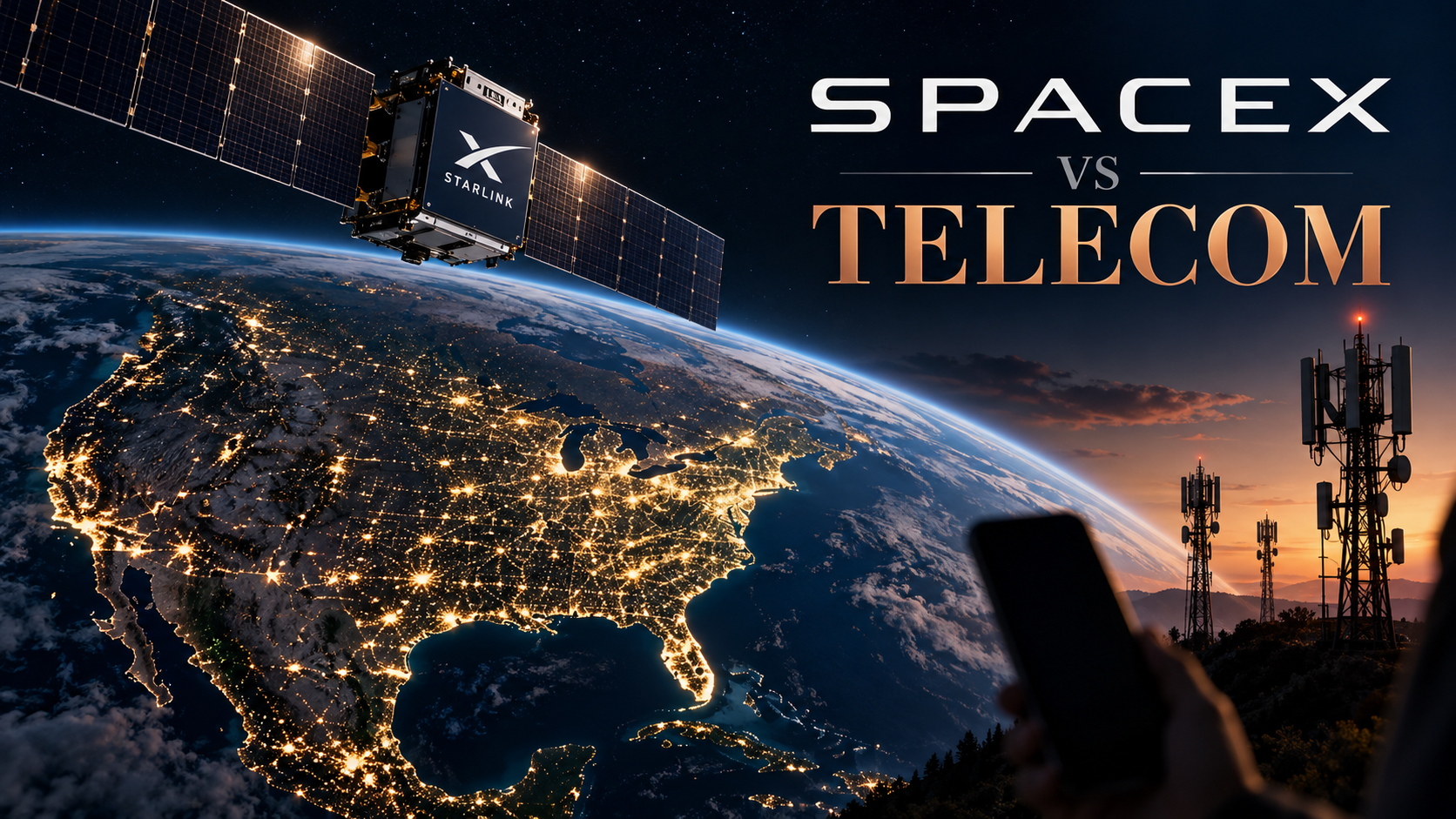
SpaceX has become one of the busiest names in finance-focused discussions on X, but a ranking is not the investment story. The story is a newly public aerospace and connectivity company attempting to turn satellite access into a direct competitive challenge to terrestrial wireless operators. On October 9, a finance-X tracker put SPCX first in its composite buzz ranking. The same tracker listed NVIDIA, Tesla, Palantir and GameStop nearby. Its methodology combines factors including mentions and engagement, so the ranking should not be described as a complete census of posts on X. The snapshot was updated at 12:43 UTC on October 10 and is subject to change. Adanos finance-X tracker.
There is a concrete market catalyst. SpaceX has agreed to acquire low-band wireless spectrum from Grain Management for roughly $8 billion, an agreement still subject to approval. That brings Starlink Mobile closer to combining space-based connectivity with terrestrial equipment. Incumbent telecom shares sold off as investors considered what a better-funded satellite competitor might do to pricing, coverage and customer retention. Reuters spectrum explainer.
SPCX is a listed stock, not a private-company proxy
Some online descriptions still treat SpaceX as inaccessible to ordinary stock-market investors. They are outdated. SpaceX said its Class A shares began trading on Nasdaq Global Select Market and Nasdaq Texas under SPCX on June 12, 2026. The company closed the initial public offering on June 15 and said gross IPO proceeds were approximately $85.7 billion after the underwriters’ option was fully exercised. Those are company-reported offering details, not a measure of its current equity value. SpaceX investor-relations announcement.
The distinction matters for search readers comparing a listed share, privately held ventures, thematic exchange-traded funds and companies with indirect space exposure. A ticker’s presence on a sentiment board cannot confirm a company’s valuation, latest official closing price or operating profit. For those claims, readers should consult exchange data, recent filings and investor-relations disclosures. Social-media rankings are a discovery tool; they do not establish intrinsic value.
Why 800 MHz spectrum changes the strategic debate
Wireless networks operate across bands with different trade-offs. Lower frequencies tend to travel farther and penetrate buildings better than higher-frequency bands. That makes access to low-band spectrum important for reliable everyday mobile use, particularly outside dense urban coverage zones. SpaceX’s planned acquisition includes spectrum in the 800 MHz range, a band that could complement its existing satellite capabilities and allow a blended service architecture. Reuters technical explainer.
The company is not buying instant market leadership. FCC approvals, network integration, antenna deployment, customer equipment compatibility, spectrum coordination and wholesale arrangements all affect execution. The stronger strategic thesis is that Starlink could gradually move from an emergency and rural-connectivity supplement to a broader wireless offering. The weaker thesis assumes satellites alone can replace the capacity and economics of dense terrestrial networks overnight. That is not supported by the practical requirements of wireless delivery.
Why incumbent telecom shares reacted so sharply
Investors price telecom companies partly on the durability of monthly subscriber revenue. If satellite-assisted service reduces switching costs, increases rural competition or changes negotiating leverage, even a future threat can alter expectations for growth and margins. Reuters reported pronounced October 9 declines across major U.S. carriers and related European telecom stocks following the SpaceX news. That selloff is evidence of a market reaction, not proof that subscribers have already defected in meaningful numbers. Reuters telecom reaction.
There is a second-order effect many headlines miss. Satellite networks do not eliminate demand for terrestrial backhaul, towers, regulatory expertise and installation work. Infrastructure owners could potentially benefit from the investment cycle even if some operators face pressure. Yet this is conditional: investors need actual contracts, traffic forecasts and permitted deployments to connect the theory to future cash flows. Another consideration is whether consumer plans are differentiated on reliability or price rather than on branding alone.
The economics investors should actually measure
A credible investment case needs unit economics. Watch how much network capacity a new satellite or ground installation supplies, how quickly capacity is monetized, the cost of acquiring a subscriber, recurring revenue per user and the cost of maintaining spectrum rights. Capital expenditure is not automatically a problem if it produces attractive lifetime customer economics; neither is it automatically productive merely because the network is technically impressive.
Connectivity has two constraints: geographic reach and traffic density. Satellites are well suited to bringing service where towers are difficult to justify. Urban networks are different. Millions of devices consuming streaming video in compact areas create enormous throughput requirements. A hybrid network may be a more plausible long-term answer than a single infrastructure model. A useful editorial test is to ask what service users get in a crowded city, inside a building and in a remote canyon—and what it costs to provide each.
Regulation is part of the competitive moat
No communications operator can treat spectrum as an unregulated raw material. License transfers and deployment rules require government processes, and international services carry additional country-by-country constraints. The FCC is also considering other direct-to-device spectrum changes, putting more rulemaking events on investors’ calendars. Reuters FCC coverage.
Approvals can move slower than a market narrative. They can require commitments, alter deal terms or be delayed by technical objections. That is why the announcement date, likely closing conditions and subsequent engineering milestones deserve separate entries in a timeline. Editorial coverage should avoid reporting proposed licenses as assets already transferred or proposed service coverage as existing, commercially available coverage.
Bull case, bear case and the neutral middle
The bullish case is that SpaceX combines launch capacity, an established satellite business, a growing connectivity footprint and newly acquired spectrum to introduce services few competitors can replicate rapidly. Success could create additional recurring revenue and expand the addressable market beyond traditional satellite broadband. The bearish case is that the company commits substantial capital to a low-margin consumer telecom business while regulation, engineering and competing networks delay the payoff.
Between those extremes lies a more pragmatic possibility: Starlink Mobile becomes an important complement to conventional operators and selectively competes for premium, rural or underserved subscribers. That outcome could still be commercially meaningful without wiping out terrestrial carriers. Investors should be wary of confusing the size of the market with the portion that one company can serve profitably.
A dated checklist for the next quarterly updates
Over the coming months, watch regulatory updates on the spectrum transfer; revised Starlink Mobile service plans; satellite launches and coverage data; carrier partnerships; customer acquisition announcements; operating-margin disclosure; and the balance between capital raising and recurring cash generation. Compare these measures with the company’s filings rather than relying on daily buzz scores.
Also track AT&T, Verizon and T-Mobile’s response. Price reductions, revised satellite alliances and accelerated rural deployment may reveal that competitive pressure is real even before customer losses become visible in published subscriber counts. Equally, a stabilization of churn and pricing would undermine the most aggressive disruption forecasts.
What this means for readers
The most useful question is not whether SPCX was trending first at a specific moment. It is whether the new wireless strategy improves the future cash-generation ability of SpaceX more than it increases capital requirements and operational complexity. The October spectrum news makes the competitive threat more credible, but the economics remain a series of milestones to verify—not a settled outcome.
Frequently asked questions
Is SpaceX stock publicly traded in October 2026?
Yes. SpaceX announced SPCX trading commenced in June 2026; readers should check a current market-data provider for live pricing, because this article does not supply a real-time quote.
Why did telecom stocks fall?
Investors reassessed future competition after SpaceX’s low-band spectrum announcement. Share-price reactions do not prove that the acquisition has closed or that Starlink has already captured large numbers of conventional cellular customers.
Can Starlink Mobile replace cell towers?
Satellites can improve coverage, but urban capacity and indoor connectivity have different engineering and cost constraints. A hybrid arrangement involving terrestrial assets is an important possibility.
Does a high X buzz score mean SPCX is a buy?
No. Sentiment is a measure of attention within a sampled data set, not a valuation method or an investment recommendation.


