


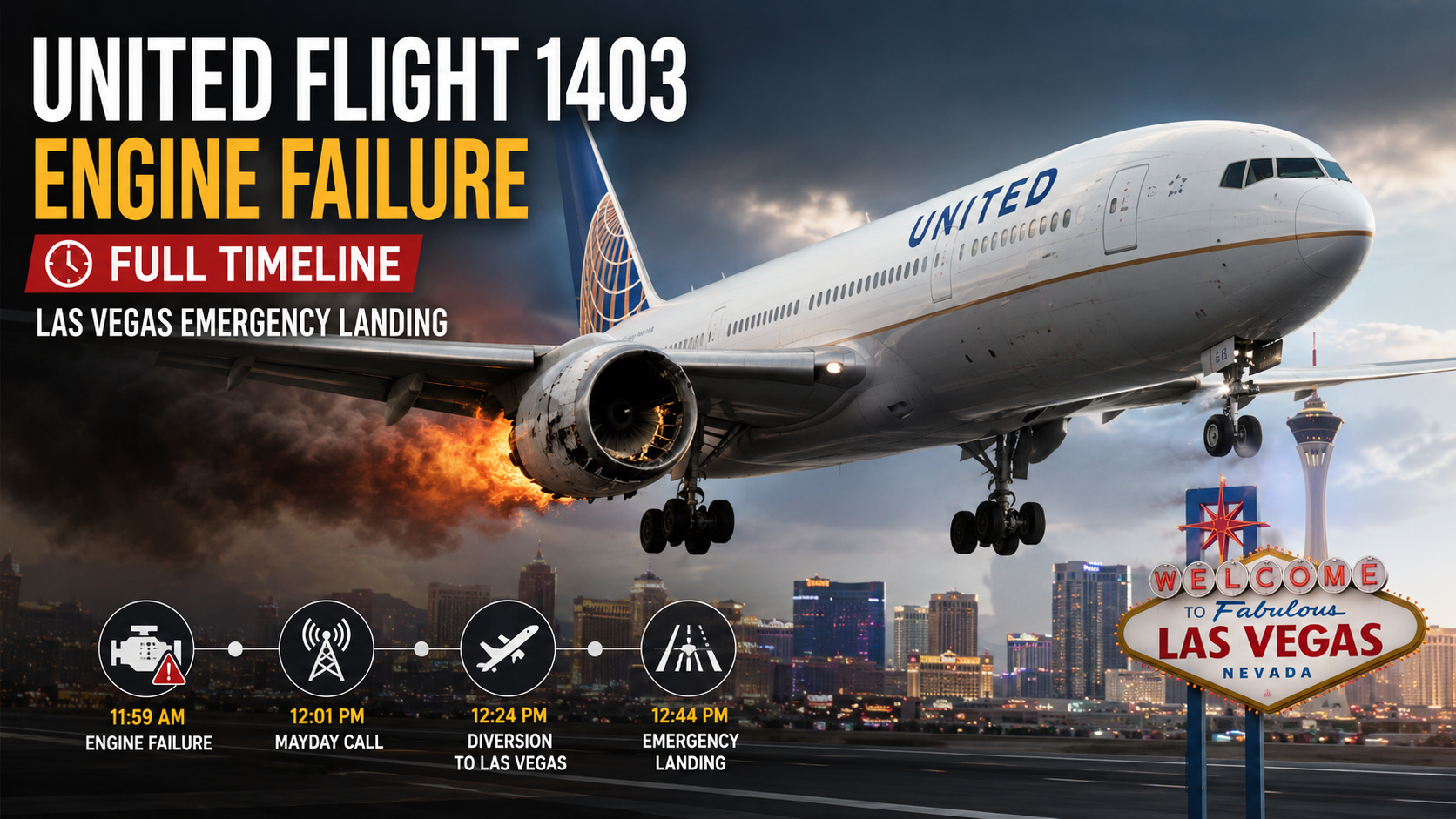
United Airlines Flight 1403, a Boeing 757-200 carrying 176 passengers and seven crew members from Los Angeles to Newark, suffered an engine problem at 31,000 feet on August 27, 2026, and diverted to Harry Reid International Airport in Las Vegas, landing safely with no injuries reported. Passengers described the incident as “terrifying,” and the disruption cascaded into more than 30 hours of delays for some travelers, who were rerouted through Cleveland before finally reaching Newark. The FAA said it would investigate. The incident came just days after a separate United flight, UA169, diverted to London’s Heathrow Airport during a transatlantic crossing due to a mid-flight mechanical alert — reviving scrutiny of aging fleet maintenance and mechanical reliability across United’s network.
Timeline of the Incident
Flight UA1403 departed Los Angeles International Airport around 6 a.m. local time on Thursday, August 27, 2026, bound for Newark Liberty International Airport on a flight that should have taken roughly five and a half hours. Instead, according to FlightAware tracking data and passenger accounts, the crew reported an engine problem approximately 40 minutes into the flight, while cruising at 31,000 feet. One passenger, Thomas P. Smith, posted to social media in real time: “United Flight 1403 LA to NY… engine failure at 31,000 feet! Emergency landing at Las Vegas Airport. Terrifying!” — a post that quickly circulated and became the primary public documentation of the incident before official statements caught up.
The aircraft, a Boeing 757-200, landed safely at Harry Reid International Airport around 7 a.m. Pacific time and reached the gate by 7:39 a.m. All 176 passengers and seven crew members deplaned safely in Las Vegas, and United confirmed no injuries. Some reporting on the incident described the aircraft descending from roughly 30,000 to 17,000 feet and dumping fuel prior to landing — a standard emergency procedure used to reduce aircraft weight before an unscheduled touchdown, though official confirmation of the specific descent profile and fuel-dump sequence has not been independently verified by all outlets covering the event.
Key Takeaways
- United Airlines Flight 1403 (LAX to EWR) suffered an engine problem at 31,000 feet on August 27, 2026, and diverted safely to Las Vegas with no injuries among 176 passengers and 7 crew.
- The Boeing 757-200 landed at Harry Reid International Airport but did not depart again for nearly eight hours, cascading into more than 30 hours of total disruption for some connecting passengers.
- The incident followed a separate United mechanical diversion days earlier — Flight UA169, which diverted to London Heathrow during a Venice-to-Newark transatlantic crossing.
- The FAA said it would investigate; the specific technical cause of the Flight 1403 engine issue had not been publicly confirmed as of this writing.
- United’s continued operation of aging Boeing 757-200 aircraft raises ongoing fleet-maintenance and capital-expenditure questions for airline-sector analysts.
- No cash compensation is federally mandated for mechanically caused U.S. domestic delays, though airlines must provide rebooking and accommodations.
The Aftermath: A 30-Hour Odyssey
The operational disruption extended well beyond the emergency landing itself. FlightAware data shows the aircraft did not depart Las Vegas again until 3:54 p.m. Pacific time that day — more than seven hours after landing — eventually reaching Cleveland-Hopkins International Airport at 11:30 p.m. Eastern and pulling into the gate at 12:30 a.m. the following day. For passengers like Smith, that meant a roughly 16.5-hour journey from Los Angeles to Cleveland alone, followed by a further 12-hour wait for the next available connection to Newark, scheduled for 1 p.m. Saturday — meaning some travelers faced a total disruption window exceeding 30 hours from original departure to eventual arrival. United responded directly to affected passengers on social media, stating: “We’re sorry to hear about this experience.”
Not an Isolated Incident This Week
The Las Vegas diversion was not United’s only mechanical incident in the surrounding days. Just days earlier, United Flight 169, en route from Venice Marco Polo Airport to Newark, encountered a mid-flight technical issue after departing at 11:21 a.m. local time and diverted to London Heathrow instead of continuing across the Atlantic. That aircraft, carrying 216 passengers, reportedly descended from approximately 30,000 feet to 17,000 feet after crew issued an alert related to a mechanical problem, following a flight path across Austria, Germany, and Belgium before diverting. The proximity of the two incidents — a domestic engine failure and a transatlantic mechanical diversion within the same week — has drawn attention to United’s broader maintenance and reliability record, even though the FAA has not indicated the two events share a common technical cause.
The FAA confirmed it planned to investigate the Flight 1403 incident, though as of this writing, neither the airline nor federal investigators have publicly specified the exact nature of the engine malfunction — whether it involved a compressor stall, a mechanical failure of engine components, a bird strike, or another cause.
Financial and Market Impact Section
Reputational and Compensation Exposure for United
Airline diversions of this nature carry real, if bounded, financial costs: unscheduled landing fees, crew rest and duty-time rule compliance (which can force a full crew swap and extended ground time, as appears to have happened here), rebooking costs across multiple connecting itineraries, and Department of Transportation-mandated compensation or accommodation obligations for stranded passengers depending on cause classification. Airlines are generally not required to pay cash compensation for mechanically caused delays under current DOT rules (unlike EU261-style frameworks), but are obligated to provide rebooking, and reputational costs — passenger goodwill, social-media amplification of “terrifying” incident footage, and potential shifts in booking behavior on the LAX-EWR corridor — represent a less quantifiable but real cost to the airline’s brand.
Boeing 757 Fleet-Age Considerations
United continues to operate a sizable fleet of Boeing 757-200 aircraft, a model no longer in production, whose average fleet age across U.S. carriers now regularly exceeds two decades. While an aging airframe alone does not indicate elevated risk when properly maintained under FAA-mandated inspection cycles, incidents like this one tend to intensify market and regulatory scrutiny of aircraft-maintenance capital expenditure across legacy carriers, an area airline-sector equity analysts watch closely given its direct link to both safety outcomes and operating-cost trajectories as airlines weigh continued 757 utilization against newer narrow-body replacement programs from Boeing and Airbus.
Insurance and Aviation-Safety Market Signals
Each publicized in-flight mechanical event feeds into the aviation-insurance underwriting cycle and informs airline safety-rating services used by corporate travel-risk-management platforms — a niche but high-CPC advertising vertical given its overlap with enterprise travel-policy software and corporate insurance products. A cluster of incidents within a short window, even without any confirmed common cause, can influence renewal pricing conversations between airlines and their hull and liability insurers well before any formal NTSB or FAA findings are issued.


