


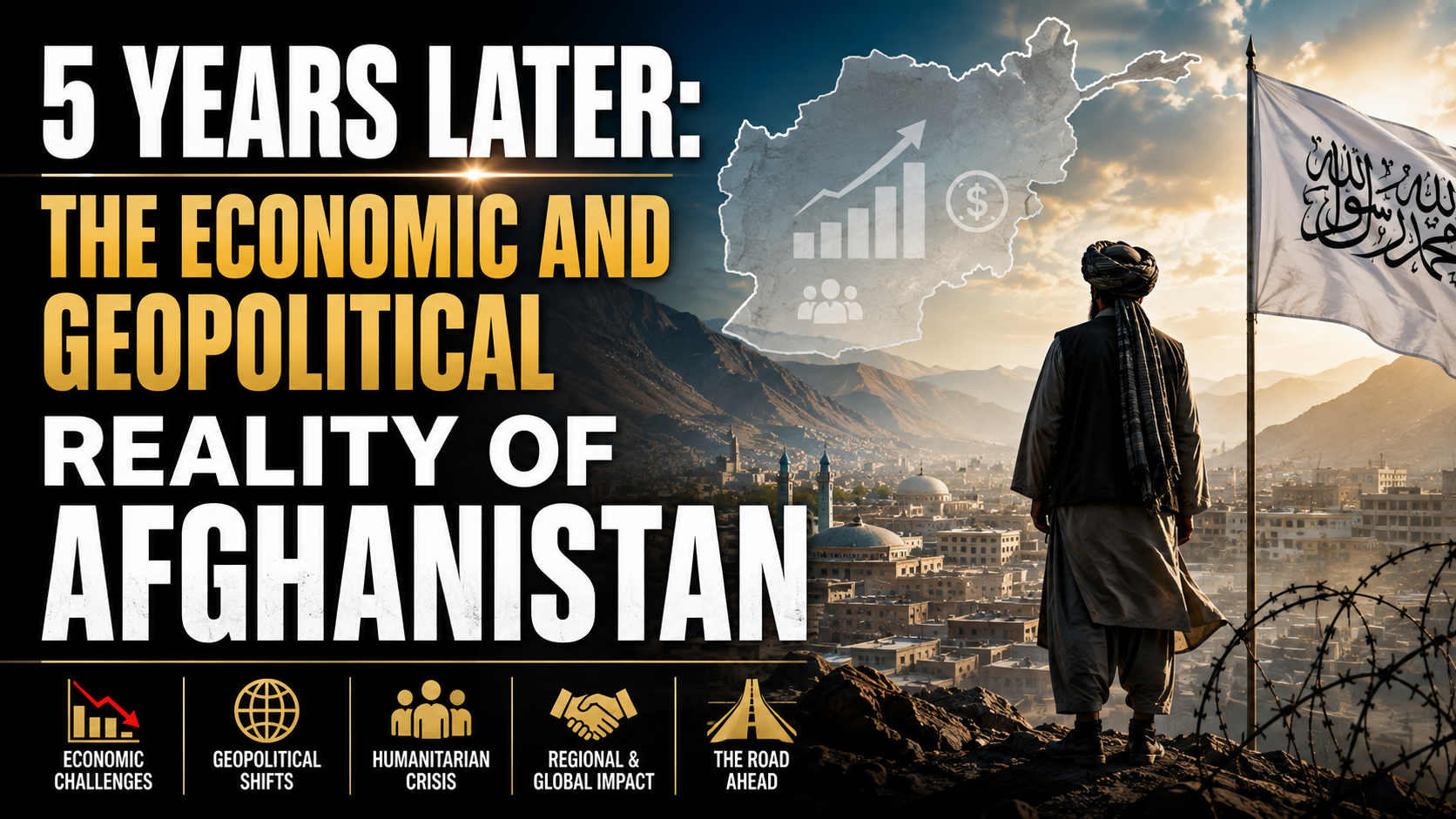
On August 15, 2026, white Taliban flags lined the streets of Kabul as the movement marked five years since its return to power, with ceremonies held at the Loya Jirga assembly hall, according to Countercurrents. Beneath the commemorative optics sits a genuinely bifurcated economic and geopolitical story — one of surprising macro-level stabilization alongside continued humanitarian catastrophe and near-total exclusion from formal Western capital markets. For foreign-policy-adjacent investors and enterprise strategists evaluating frontier and Central Asian exposure, Afghanistan’s five-year reality offers a sobering case study in what happens when a state achieves security consolidation without international financial reintegration.
The Fiscal Paradox: Growth Without Foreign Aid
Before 2021, foreign aid financed roughly three-quarters of Afghanistan’s public expenditure, according to CNN. That funding has largely evaporated, and billions of dollars in central bank reserves remain frozen by the US and its allies — reportedly $9.5 billion frozen as of August 2021, according to UA.News. Yet, counterintuitively, the World Bank estimated Afghanistan’s real annual GDP growth at nearly 5% earlier in 2026, according to Foreign Policy — driven substantially by the Taliban’s success in generating revenue through customs duties and tax collection, plus robust trade with Central Asian neighbors.
This is the paradox investors need to understand: domestic fiscal consolidation has occurred without international reintegration. The Taliban has proven more effective at domestic revenue collection than many observers expected, while remaining almost entirely cut off from the international financial system that would allow that growth to compound through foreign direct investment.
The China Case Study: A Cautionary Tale for Resource Investors
China’s approach to Afghanistan illustrates the limits of even a willing external investor operating without US-style military commitment. In January 2023, China’s Xinjiang Central Asia Petroleum and Gas Co. (CAPEIC) signed a 25-year, $540 million oil production contract in the Amu Darya basin — but by June 2025, the Taliban had officially cancelled the agreement over the company’s failure to meet investment obligations, according to UA.News. Beijing’s broader model in Afghanistan — diplomatic contact and resource-access agreements without large-scale military or infrastructure presence — has nonetheless continued via projects like the Wakhan Corridor road, intended to link Afghanistan directly with China and reduce Kabul’s dependence on Pakistan, per Countercurrents.
The Humanitarian Scorecard
The economic stabilization narrative sits alongside a severe and ongoing humanitarian crisis:
- Nearly 24 million people — more than half of Afghanistan’s population — need humanitarian aid, according to the UN, as cited by UA.News.
- Approximately 45% of the population requires humanitarian assistance, per CNN, with aid dramatically cut by international donors and women and girls bearing the brunt of those cuts.
- The frozen central bank reserves remain one of the Taliban’s primary bargaining chips in talks with Western governments — with the ban on girls’ education as a key sticking point, meaning the very funds that once financed girls’ schooling are now withheld specifically to try to restore it, a dynamic CNN describes as circular.
Security Consolidation: The Taliban’s Clearest Achievement
The most consistently acknowledged Taliban achievement across all sources is security. After four decades of continuous conflict, Afghanistan has witnessed a significant decline in large-scale violence, according to Countercurrents. Foreign Policy notes Afghanistan has not been at war since August 2021, a historic first after four decades of conflict, though ISIS-Khorasan (IS-K) attacks have periodically targeted the regime without threatening its political survival.
Diplomatic Reality: Isolated but Not a Pariah
Nearly 20 countries still maintain diplomatic representation in Kabul, and Taliban diplomats have taken posts in multiple Asian capitals, according to Foreign Policy. Even so, formal recognition and visa access remain limited: a private Kabul business was reportedly advertising Turkish visas for $1,000 in summer 2026 despite Ankara hosting Taliban diplomats since 2023, while India and Russia — both close Taliban partners — have yet to deliver on promised expanded visa programs, according to The New Humanitarian.
Five-Year Economic and Political Scorecard
| Dimension | 2021 Baseline | 2026 Status |
|---|---|---|
| Public expenditure financed by foreign aid | ~75% (pre-2021) | Near-zero; replaced by customs/tax revenue |
| Real GDP growth | Sharp contraction post-takeover | ~5% (World Bank estimate, 2026) |
| Frozen central bank reserves | $9.5B frozen (Aug 2021) | Remains frozen; key negotiation leverage |
| Security situation | Active 4-decade conflict | No active war since 2021; periodic IS-K attacks |
| Humanitarian need | Escalating post-takeover | ~45–50% of population requires aid |
| Diplomatic recognition | None | No formal recognition; ~20 countries maintain missions |
| Major foreign resource deals | N/A | China CAPEIC oil contract signed 2023, cancelled 2025 |
Sources: CNN, Foreign Policy, Countercurrents, UA.News, The New Humanitarian — see citations above.
What This Means for Frontier-Market and Regional Investors
- Afghanistan remains functionally uninvestable for Western institutional capital absent reserve unfreezing, which itself is tied to unresolved human-rights conditions unlikely to shift near-term.
- China’s CAPEIC cancellation is a signal, not an anomaly. Resource-sector investors evaluating Central Asian frontier plays should treat the episode as evidence that even politically aligned external investors face genuine contract-enforcement and delivery risk in Afghanistan.
- Regional trade corridors (Wakhan, TAPI pipeline ambitions) are the more realistic near-term investment thesis than direct Afghan-domiciled projects — infrastructure that reduces Pakistan-transit dependency carries strategic value for China and Central Asian neighbors independent of Afghanistan’s own investment climate.
- The customs/tax revenue model is a genuine, underappreciated data point for anyone modeling regional trade flows through Afghan territory — it suggests functioning, if narrow, state capacity that could support targeted trade-facilitation engagement even absent broader normalization.
The Bottom Line
Five years on, Afghanistan presents a rare case where security consolidation and baseline fiscal functioning have outpaced humanitarian conditions and international reintegration by a wide margin. For investors and enterprise strategists, the actionable takeaway isn’t a binary “is Afghanistan investable” question — it’s recognizing that regional trade-corridor and customs-revenue dynamics are real and measurable, while direct capital deployment remains blocked by frozen reserves, human-rights-linked recognition conditions, and documented contract-enforcement risk exemplified by the CAPEIC cancellation.


