


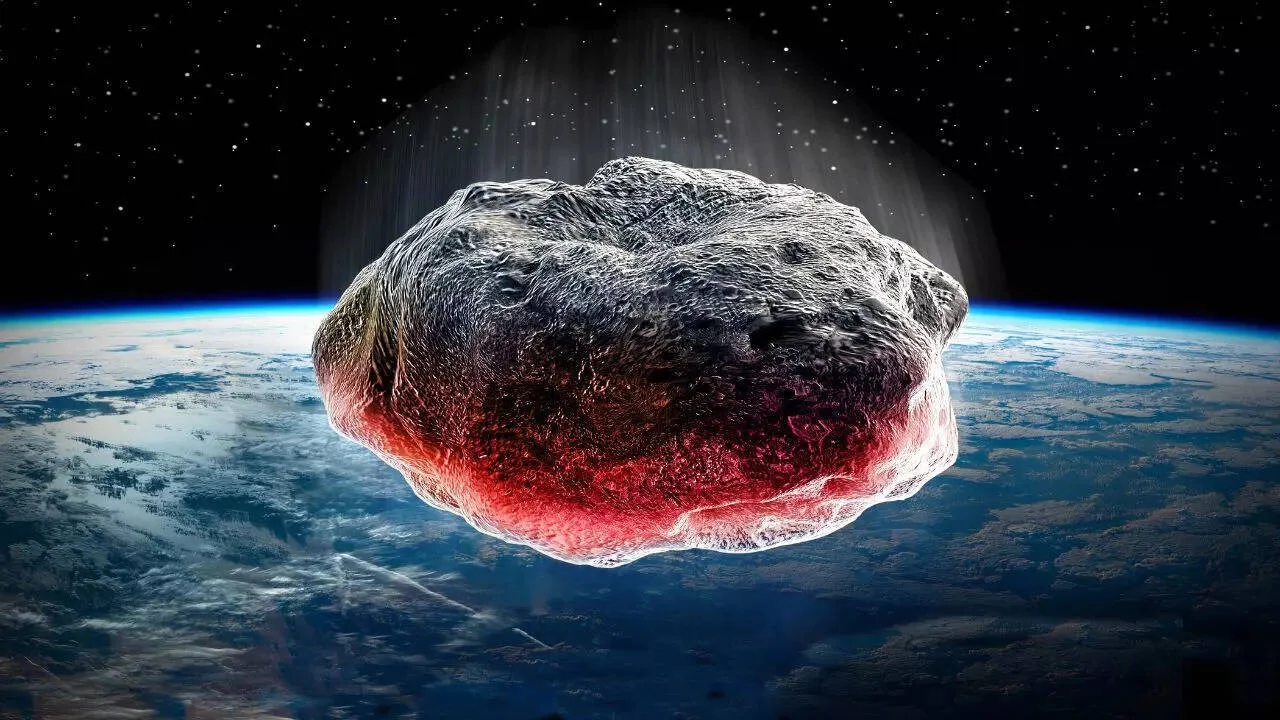
Has NASA warned of an asteroid impact in 2026? No credible, currently active NASA warning points to an asteroid striking Earth in 2026 itself. Multiple viral social media claims circulated this year alleging specific impact warnings — including one claiming a 2% chance of an asteroid strike on Valentine’s Day — and each has been traced back to either outdated data, misattributed figures, or outright fabrication, according to fact-checking by FactCrescendo. NASA’s Center for Near-Earth Object Studies (CNEOS) maintains a publicly accessible Sentry Earth Impact Monitoring table specifically so anyone can verify these claims directly rather than relying on secondhand social media posts.
That distinction — between real, transparently published tracking data and viral misinformation — is the single most important thing to understand about asteroid coverage in 2026.
The Real Case That Fueled the Panic: Asteroid 2024 YR4
Featured Snippet Target: Asteroid 2024 YR4, first spotted in late 2024, briefly carried a 3.1% probability of striking Earth in 2032 as of February 2025 — described by NASA at the time as the highest impact probability the agency had ever recorded for an object of its size — before additional observations progressively lowered that probability, eventually ruling out any significant impact risk to Earth in 2032 or beyond.
This case is the real origin point behind much of the “2%” and “3%” figures that continue to circulate online, often stripped of their original context and reattached to different, more alarming dates. As tracking continued, NASA’s calculations showed the probability of an Earth impact dropping steadily toward zero, with some scientists instead suggesting the asteroid’s orbit could bring it close to the Moon in December 2032 rather than Earth, according to reporting from Newsweek. As of 2026, NASA notes the object is currently too far away to observe with either space- or ground-based telescopes, and expects to resume observations when its orbit brings it back into range in 2028.
Understanding NASA’s Actual Risk Scale
To put any individual asteroid headline in context, NASA’s own size-based risk framework is instructive:
- Objects up to 30 feet across strike Earth roughly once every ten years, typically producing a bright fireball and sonic boom with no significant damage.
- Objects around 160 feet or larger strike Earth roughly once every 1,000 years, with the potential to cause local devastation and leave an impact crater.
- Objects over 3,000 feet strike roughly once every 700,000 years and could cause civilization-level disruption.
- Objects over 6 miles across — the scale associated with mass-extinction events — strike only about once every 100 million years.
This scale, reported by Newsweek drawing on NASA data, is why space agencies distinguish sharply between routine “close approach” news stories — which happen frequently and almost always involve zero impact risk — and genuine planetary-defense concerns, which are exceptionally rare.
What Real Close Approaches Looked Like in 2026
Several real, well-documented asteroid flybys occurred in 2026, none carrying any meaningful impact risk. A bus- or house-sized asteroid designated 2026 AW, at roughly 14.5 meters (47.6 feet) wide, passed safely by Earth on January 11, 2026, with NASA confirming no impact risk, according to tracking summarized by asteroid-monitoring outlets. Separately, asteroid 2026 JH2 — estimated at 50 to 108 feet in diameter and first spotted by the Catalina Sky Survey’s Mount Lemmon facility in Arizona — passed more than 56,900 miles from Earth, with Harvard astrophysicist Avi Loeb rating it a zero on his object-classification scale, according to AccuWeather.
These routine flybys are a normal and expected feature of near-Earth object tracking — NASA monitors more than 35,000 known near-Earth asteroids on an ongoing basis, and the overwhelming majority pose no risk whatsoever.
The “2026 PDC27” Exercise — A Simulation, Not a Real Threat
One document circulating in space-interest communities in 2026 deserves particular clarification: a series of “Potential Impact Notification” bulletins referencing an object called “2026 PDC27,” with impact probabilities described as rising from 16% to 19% for a hypothetical impact date of July 10, 2038. These bulletins are explicitly and repeatedly labeled “EXERCISE EXERCISE EXERCISE” in their original text, published by the International Asteroid Warning Network as part of a scheduled Planetary Defense Conference tabletop simulation — a hypothetical scenario designed to test how space agencies, governments, and emergency planners would coordinate in response to a genuine threat, not a real asteroid discovery.
This distinction matters enormously for anyone encountering screenshots or excerpts from these documents online: the scenario, the probabilities, and the described “impact corridor” spanning the Pacific Ocean, North America, and parts of Europe are all fictional elements of a planning exercise, not an active NASA warning. Space agencies run these simulations precisely because a real, once-in-a-generation warning would need to be communicated clearly and rapidly — and confusing a training exercise with an actual alert undermines that goal.
Why NASA Keeps Emphasizing Planetary Defense Anyway
Even without any active 2026 threat, NASA officials continue to stress the importance of long-term planetary-defense investment. Asteroid expert Humberto Campins told reporters that while no individual person needs to worry about an asteroid impact personally, human civilization as a whole should continue strengthening its planetary-defense capabilities, because a significant impact event will eventually recur — a matter of geological timescale rather than any specific near-term prediction, according to reporting from Primicias.
That is the accurate, non-alarmist framing worth taking from 2026’s asteroid coverage: routine close approaches are normal and safe, the real 2024 YR4 scare has been fully resolved, viral “NASA warning” claims circulating on social media should be checked directly against NASA’s public Sentry database before being believed, and planetary-defense research continues as a sensible long-term precaution rather than a response to any current emergency.
The Bottom Line
There is no credible NASA warning of an asteroid striking Earth in 2026. The viral claims that keep resurfacing trace back either to a resolved 2024–2025 scare (2024 YR4) that has since been ruled out, or to a misunderstood planetary-defense training exercise never intended to represent a real threat. Genuine close approaches happen regularly and are almost always harmless, exactly as NASA’s own size-based risk framework predicts.
Next step: Anyone encountering an “asteroid impact warning” online should check it directly against NASA’s public Sentry Earth Impact Monitoring table before sharing it further — that single step would have prevented most of 2026’s viral asteroid misinformation from spreading in the first place.


