


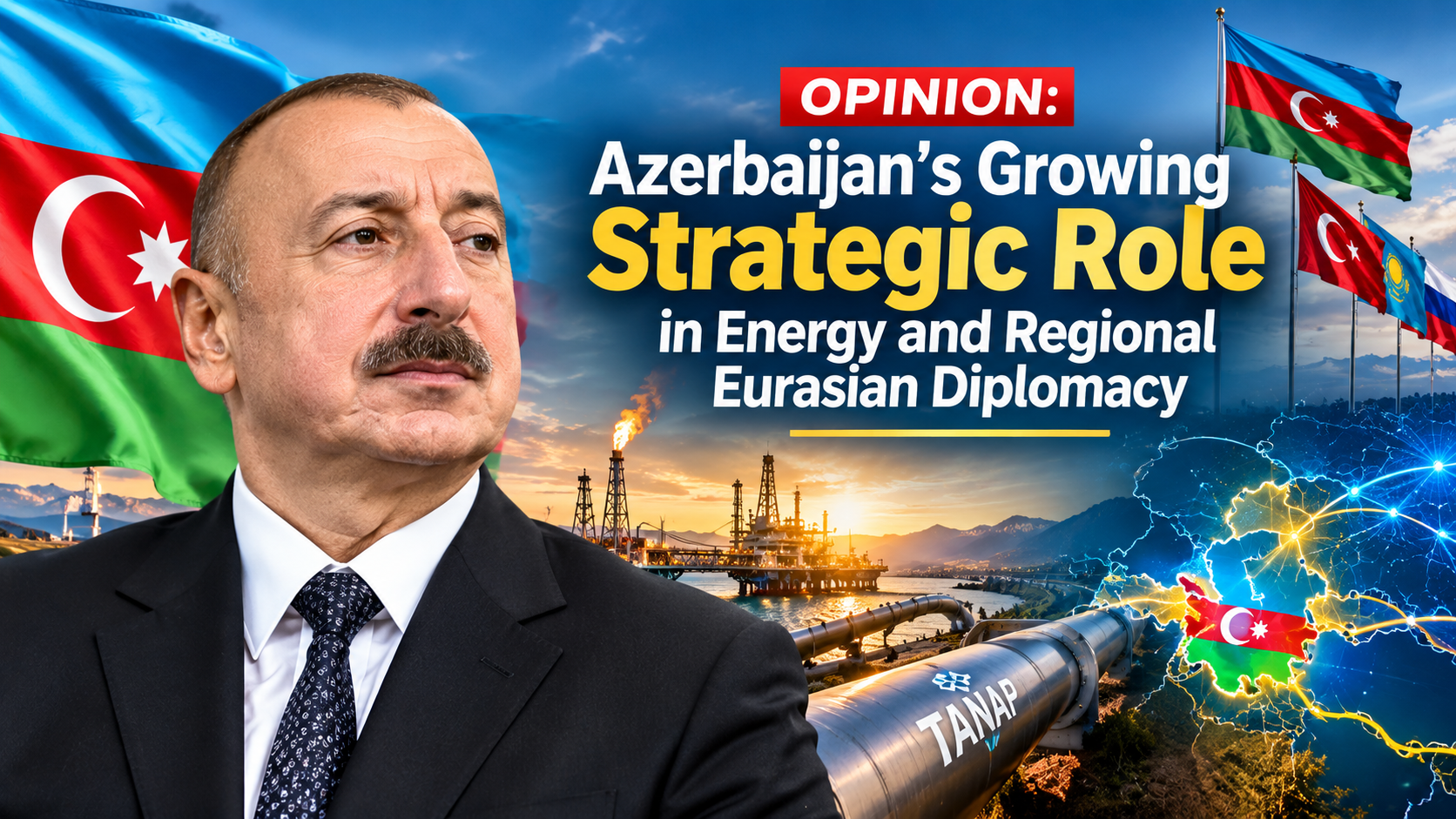
Azerbaijan pumped 51.5 bcm of gas in 2025 and exports to 16 countries. Inside TRIPP, the Middle Corridor and the limits of Baku’s supply to Europe.
Executive Summary / Key Takeaways
- Azerbaijan produced more than 27 million tonnes of crude oil and 51.5 bcm of gas in 2025 — more than triple its 2007 gas output — and now exports oil to nearly 30 countries and gas to 16, including 10 EU member states.
- Around 13 bcm of gas reached European markets in 2025, roughly 60% more than in 2021, via the Southern Gas Corridor.
- The critical constraint is volume, not willingness: the Southern Gas Corridor is expected to pump around 12.8 bcm in 2026, with Baku’s own energy ministry indicating little additional capacity available for Europe this year.
- TRIPP — the Trump Route for International Peace and Prosperity — is a 42-kilometre rail and road corridor through Armenian territory agreed in the August 2025 White House Joint Declaration, forming the South Caucasus link in the wider Middle Corridor.
- Azerbaijan aims to complete its section of the expanded corridor by the end of 2026.
1. Introduction & Immediate Context
Azerbaijan’s strategic weight does not come from reserve size. Measured against Russia, Qatar or Iran, its hydrocarbon base is modest. Its weight comes from position — and from a decade of converting that position into contracted infrastructure.
In 2025 the country produced more than 27 million tonnes of crude oil and 51.5 bcm of gas, more than triple its 2007 gas output, and now exports oil to nearly 30 countries and gas to 16, including 10 EU member states, according to Euronews. With the EU’s gas import dependency now exceeding 85%, the Southern Gas Corridor has become a key pillar of European supply security, opening the bloc’s fourth gas supply corridor when Azerbaijani gas first reached Europe via the Trans Adriatic Pipeline in 2020. Around 13 bcm were delivered to European markets in 2025, roughly 60% more than in 2021. The Shah Deniz field, the corridor’s primary supply source, has produced 267 bcm of gas and more than 52 million tonnes of condensate to date.
Those numbers explain the diplomatic attention. What follows explains its limits.
2. Core Strategic Analysis
2.1 The energy balance sheet
| Metric | Figure | Context | Source |
|---|---|---|---|
| Crude production (2025) | 27m+ tonnes | Exports to nearly 30 countries | Euronews |
| Gas production (2025) | 51.5 bcm | More than triple 2007 output | Euronews |
| Gas exports (total) | 25.2 bcm | 12.8 bcm to Europe; rest to Türkiye, Georgia, Syria | Caucasian Knot |
| Southern Gas Corridor (2026 est.) | ~12.8 bcm | Broadly flat year-on-year | Caucasian Knot |
| Shah Deniz cumulative | 267 bcm gas, 52m+ tonnes condensate | Corridor’s primary supply source | Euronews |
| EU gas import dependency | Above 85% | Structural demand for diversification | Euronews |
2.2 The volume ceiling nobody quotes
This is where most commentary overstates Azerbaijan’s substitutability for Russian supply. Of 51.5 bcm produced, roughly 25.2 bcm is exported — 12.8 bcm to Europe, the remainder to Türkiye, Georgia and Syria — with the balance, including 2.6 bcm from Shah Deniz plus output from the Umid and Absheron-1 fields and SOCAR facilities, retained for domestic needs, according to energy analyst commentary reported by Caucasian Knot. The Southern Gas Corridor is expected to pump approximately 12.8 bcm in 2026, roughly flat on the prior year, with no other volumes available. Potential additions cited were around 500 million cubic metres from deep-lying formations in the Azeri-Chirag-Guneshli project — about 0.1% of the European gas market — and a further 200 million cubic metres freed by the launch of the Khizi-Absheron wind farm.
That is the ceiling. Azerbaijan is a diversification asset for Europe, not a replacement supplier, and the difference is roughly an order of magnitude.
2.3 TRIPP and the corridor economics
The connectivity story has more upside than the molecules story.
TRIPP is a 42-kilometre rail and road corridor through Armenian territory, brokered as part of the August 2025 White House peace declaration between Armenia and Azerbaijan. It forms the South Caucasus link in the wider Middle Corridor — the Trans-Caspian International Transport Route — connecting China and Central Asia through Azerbaijan, Georgia and Türkiye to Europe.
The Carnegie Endowment has documented what the route resolves. Azerbaijan had called for reopening the link to its Nakhchivan exclave across Armenia, referring to it as the “Zangezur corridor” — language Yerevan read as threatening annexation, while Baku insisted it had no territorial claim. TRIPP aims to unlock that impasse by restoring the link to Nakhchivan while respecting Armenian sovereignty and jurisdiction, with the primary objective being restoration of the old rail line running along the Armenia-Iran border. Confidence-building has already begun: Aliyev lifted a long-standing ban on transit to and from Armenia via third countries, and between December 2025 and March 2026 Azerbaijan sent several fuel shipments, including gasoline and diesel, to Armenia by rail via Georgia.
Timelines are firming. Armenian Prime Minister Nikol Pashinyan indicated construction should begin in the second half of 2026, with TRIPP comprising a railway tracing an existing Soviet-era course, a natural gas pipeline and a power line, OilPrice reported. Unresolved details include the potential role of American contractors in administering operations and providing security, with Pashinyan insisting Armenia retains sovereign rights over the route. Azerbaijan aims to complete its own section by the end of 2026, and Azerbaijan Railways began reconstruction of Nakhchivan’s railway infrastructure in December 2025, per Caspian News.
3. Structural Drivers and Competitor Gaps
The Georgia question is the unpriced variable. The IMF has noted that a protracted Middle East conflict could redirect additional transit toward Georgia along the Middle Corridor, while an Azerbaijan-Armenia peace agreement could generate new routes bypassing Georgia, per Times of Central Asia analysis. Both statements are true and they point in opposite directions. Kazakhstan has responded by working at ministerial level to reinforce the Azerbaijan-Georgia segment, which remains the operative channel today, signing a 2026–2027 foreign-ministry cooperation programme with Tbilisi in April.
Electricity is the next layer. Azerbaijan and Türkiye are gradually adding an energy layer to the corridor, moving from oil and gas to electricity and from conventional hydrocarbons to renewable power, according to the Saratoga Foundation. The most geopolitically sensitive of the projects under discussion is the Nakhchivan line, because the exclave has no land connection to the rest of Azerbaijan except through Armenian and Iranian territory. Any electricity link reaching both Nakhchivan and Türkiye points toward the same corridor now being rebuilt for rail. Separately, the EU and Azerbaijan are developing three green energy corridors following a 2022 strategic partnership agreement signed in Bucharest with Georgia, Romania and Hungary.
Baku understands narrative as infrastructure. Hosting COP29 in 2024 and the Global Baku Forum, and convening the Southern Gas Corridor Advisory Council ministerials, are deliberate acts of positioning. The country’s energy minister has framed Azerbaijan’s role as indispensable within an evolving architecture of energy and data connectivity across the Caspian and Black Sea regions.
4. Key Implications for Stakeholders
Energy market analysts. Model Azerbaijani supply to Europe as flat at roughly 12.8 bcm through 2026. Any forecast implying material growth needs to identify which field supplies it; the answer on current disclosure is that none can at scale.
International relations specialists. TRIPP’s construction start in H2 2026 and Azerbaijan’s end-2026 section completion are the falsifiable milestones. The open question — American contractor involvement in administration and security — is where the arrangement could either institutionalise or unravel.
Logistics and supply chain executives. The Middle Corridor’s value rises with every disruption to Red Sea and Hormuz routing. With Houthi attacks having shut a crucial Saudi crude pipeline bypassing the Strait of Hormuz in September 2026, the redundancy case for Trans-Caspian routing is stronger than at any point since the route was conceived.
Regional investors. The transformation Aliyev has described — Armenia becoming a transit country for the first time in its independent history — would reprice regional logistics assets substantially if delivered. Treat it as optionality, not baseline.
5. Frequently Asked Questions
Q1: How much gas does Azerbaijan export to Europe?
Around 12.8 bcm annually via the Southern Gas Corridor, roughly 13 bcm in 2025 — about 60% more than in 2021. Total exports run near 25.2 bcm, with the remainder going to Türkiye, Georgia and Syria.
Q2: What is the TRIPP corridor?
The Trump Route for International Peace and Prosperity is a 42-kilometre rail and road corridor through Armenian territory agreed in the August 2025 White House declaration between Armenia and Azerbaijan. It restores Azerbaijan’s link to its Nakhchivan exclave while preserving Armenian sovereignty.
Q3: Can Azerbaijan replace Russian gas for Europe?
No. Its total exports are roughly 25 bcm against European demand measured in hundreds of bcm, and Baku’s own energy ministry indicates almost no additional volume is available for 2026. It functions as a diversification asset rather than a substitute supplier.
Q4: When will the Middle Corridor extension through Armenia be built?
Construction was indicated to begin in the second half of 2026, with Azerbaijan aiming to complete its own section by the end of 2026. Nakhchivan railway reconstruction began in December 2025.


