


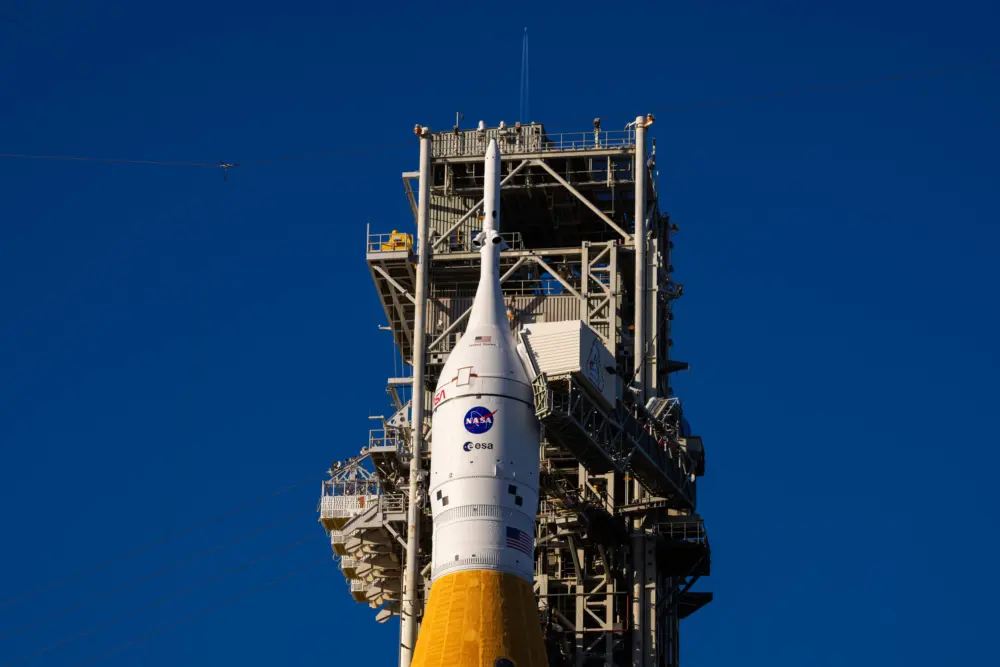
Artemis II carried astronauts around the Moon and home. Its significance lies in testing a human-rated system, not claiming a lunar landing that did not occur.
Quick answer: Artemis II carried astronauts around the Moon and home. Its significance lies in testing a human-rated system, not claiming a lunar landing that did not occur. This analysis draws on primary documents and contemporaneous reports available on November 6, 2026; subsequent market movements or policy announcements may change the outlook.
NASA’s Artemis II mission page records a launch on April 1, 2026 and splashdown on April 10, after a mission lasting nine days, one hour and 32 minutes. The four crew members were Reid Wiseman, Victor Glover, Christina Koch and Canadian Space Agency astronaut Jeremy Hansen. The mission was a crewed lunar flyby, not a landing.
NASA’s post-splashdown release explains that Orion returned the first astronauts to the Moon’s vicinity in more than half a century. The achievement is historic, but the next engineering questions remain formidable: safe repeatability, a viable landing architecture, mission economics and the management of life-support and re-entry risks.
Why a flyby was necessary before a landing
Deep-space human flight combines risks that cannot be fully reproduced by uncrewed tests. Life support, communications, navigation, crew procedures and emergency responses must work together over days outside low-Earth orbit. Artemis II allowed NASA to evaluate a crewed Orion mission through launch, lunar trajectory and Earth return.
A successful flyby does not validate every component required to land astronauts on the Moon. The lunar descent vehicle, surface spacesuits, mission sequencing and longer-term habitation tasks are separate, interconnected challenges. Treating one mission as proof of an entire program would blur those distinctions.
The significance of crew and systems integration
Engineering systems often fail at interfaces rather than within their individually tested parts. Operators must integrate ground control, rocket performance, navigation, spacecraft software, medical monitoring and crew judgment. Artemis II was an opportunity to gather evidence about the reliability of those interfaces in real conditions.
The international crew also reflects a political and institutional commitment beyond a single national demonstration. Cooperation can provide specialist capability and legitimacy, but adds coordination demands. For long-duration exploration, stable budgets and procedures are as consequential as a successful public milestone.
Heat shield and re-entry analysis
The return from a lunar trajectory imposes different thermal and speed conditions from many low-Earth-orbit missions. Re-entry protection, guidance and splashdown operations are therefore critical safety systems. A mission can end successfully and still yield engineering findings requiring design or operational changes.
NASA’s documented splashdown should be distinguished from claims that every heat-shield question is solved. Any statement about the latest inspection findings should be linked to a specific postflight technical update. Without such a source, the responsible assessment is that detailed postflight analysis remains an important part of qualifying future missions.
The next step is an architecture, not a date
Returning humans to the lunar surface requires synchronized launch capability, a functioning crew spacecraft, a lander, suits, communications, power and contingency planning. Schedule announcements are less informative without testing milestones and acknowledged dependencies.
The strategic goal is to move beyond a one-off visit toward a repeatable exploration capability. That means demonstrating not only technical success but also a governance model capable of surviving budget cycles and political changes. Artemis II is evidence of what the program can accomplish; it is not an argument that cost and schedule scrutiny should stop.
What a closer look at the source record shows
The available record supports a useful separation between confirmed developments and interpretation. The first column below identifies the type of evidence; the second explains the analytical use, not an independently measured market statistic.
| Research focus | How it informs this story |
|---|---|
| Confirmed evidence | NASA mission chronology |
| Interpretive opportunity | Fix chronology errors |
| Secondary question | Explain flyby versus landing |
| Next verification | Follow dated NASA postflight findings and officially revised Artemis III milestones rather than speculative schedules. |
The research priority is relevance rather than sheer citation volume. Repeated references to the same press release do not represent independent confirmation, and authoritative data can support a narrower claim than an ambitious headline suggests. Wherever a numerical fact is used, the source date and stated coverage should travel with it.
How to interpret the evidence without overclaiming
Demonstrated capability has limits. A test flight validates the specific configurations and conditions that were observed. It cannot automatically certify untested combinations, landing operations or future launch systems. In this article’s subject—NASA Artemis II mission—that distinction prevents superficially precise figures from becoming misleading conclusions. A credible account should explain exactly which evidence supports each inference and what would change the analysis.
Engineering evidence improves through scrutiny. Postflight inspection, anomaly review and independent risk assessment are part of progress, not signs that a successful mission should be dismissed. Follow dated NASA postflight findings and officially revised Artemis III milestones rather than speculative schedules. These checks are important because individual data points can be correct while the story assembled from them is incomplete.
Three specific tests make the coverage stronger:
- Fix chronology errors. Ask what the underlying observation actually measures, which population or companies it covers, and how recent it is. A relevant primary document outweighs a popular unsourced claim.
- Explain flyby versus landing. Compare plausible explanations and resist attributing every market or policy movement to one event. When an observed change has several possible causes, explain which are supported and which remain hypotheses.
- Identify remaining engineering gates. Describe what new fact would falsify the prevailing interpretation. Reporting that cannot be revised in the face of new evidence is advocacy, not analysis.
The engineering gates after Artemis II
Successful postflight qualification. A constructive outcome is that inspections and systems analysis identify manageable changes, while schedules for integrated tests become more reliable. Orion’s demonstrated crewed flight would then serve as one validated element of a broader lunar architecture. The mission’s documented achievement remains real even if engineers recommend improvements.
A safety finding changes the schedule. If postflight assessment or follow-on testing exposes a material issue, NASA may need additional redesign, verification or repeat tests. That is a program risk, not evidence that the April mission did not happen. Responsible reporting should distinguish technical findings published by NASA from speculation based on photographs or anonymous commentary.
Exploration progresses in stages. Landers, suits, launch systems and international partners may mature on different timelines. A credible program could adapt its mission sequence rather than claiming that every previously announced date must be preserved. The best progress measures are completed integration tests, documented closure of technical risks and a transparent schedule that includes contingencies.
A practical research checklist
A reader evaluating this issue should first open the primary sources linked in the article and check their publication dates. Next, identify the specific claim being tested, its units and its geographic or institutional scope. Then compare that evidence with at least one independent account, asking whether the sources are reporting the same underlying data or repeating one another. Finally, distinguish a dated observation from a prediction and note the developments that would demand an update.
For a working editorial desk, this sequence is equally important. A clearly dated article can remain valuable after prices or politics change if its explanations endure and its volatile numbers are identified as snapshots. An article that quietly presents yesterday’s quote as today’s fact, by contrast, loses credibility even when the broader argument is sensible.
A final distinction worth checking
Artemis II also offers an important communications lesson: a successful splashdown and a complete engineering certification are not the same milestone. NASA can celebrate the crew’s safe return while reviewing telemetry, heat-protection behavior and operational procedures. Editorial coverage should distinguish the mission’s observed flight path from estimates of future launch schedules. The most useful timeline starts with documented hardware tests and follow-on reviews, not with an independently invented date for the next crewed lunar landing.
Questions readers are asking
When did Artemis II launch?
NASA lists April 1, 2026 as launch date and April 10, 2026 as splashdown.
Did Artemis II land on the Moon?
No. It was a crewed lunar flyby and return-to-Earth mission.
Who flew on Artemis II?
NASA astronauts Reid Wiseman, Victor Glover and Christina Koch, plus CSA astronaut Jeremy Hansen.
Why was the mission important?
It tested integrated human deep-space operations in preparation for more ambitious lunar exploration missions.
The judgment
Artemis II carried astronauts around the Moon and home. Its significance lies in testing a human-rated system, not claiming a lunar landing that did not occur. The most responsible conclusion is conditional: Follow dated NASA postflight findings and officially revised Artemis III milestones rather than speculative schedules. The argument should evolve when new source material is published, rather than being defended simply because it made a compelling headline on November 6. For readers, the value is a clearer distinction among what has already happened, what remains uncertain and what developments would actually change the decision.


