


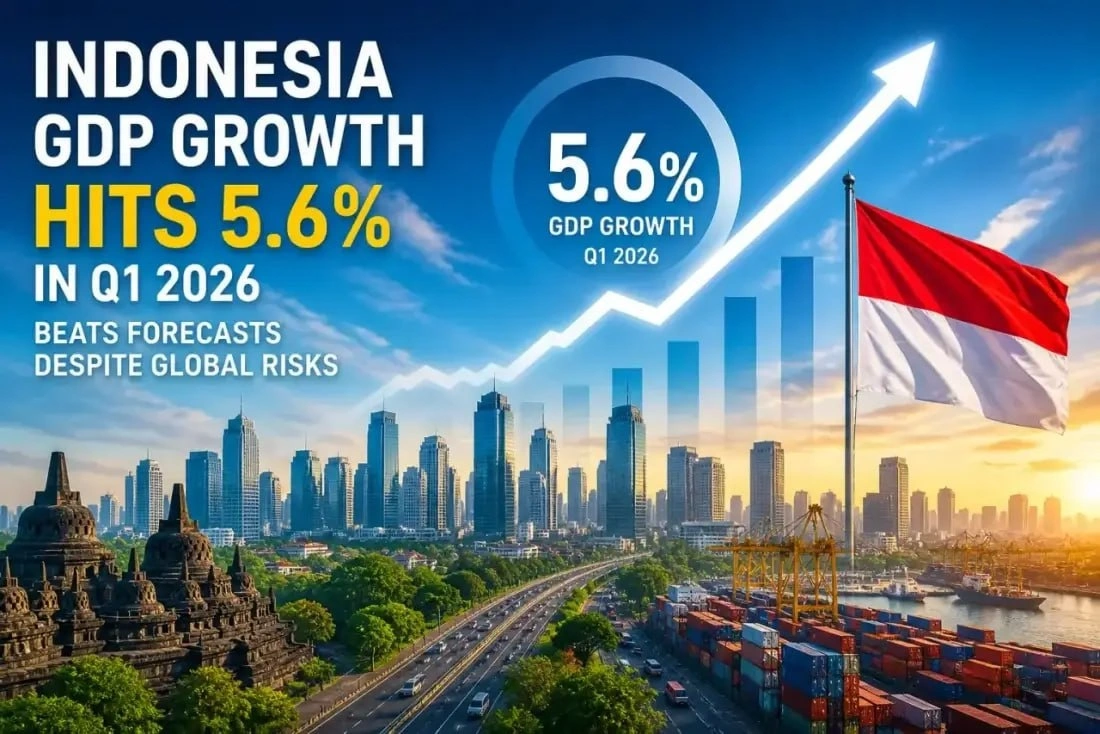
While much of the global economic conversation in mid-2026 has centered on labor-market weakness in the US, fiscal anxiety in the UK, and energy-driven volatility tied to the Middle East conflict, Indonesia has quietly delivered one of the year’s more counterintuitive economic stories: growth that came in faster than nearly every forecaster expected.
Indonesia’s statistics agency reported that gross domestic product rose 5.29% year-over-year in the second quarter of 2026, comfortably ahead of the 5.14% median estimate in a Bloomberg survey of economists — though it did represent a moderation from the 5.61% pace recorded in the first quarter. Indonesian equities gained on the release, as investors read the figure as evidence the country’s household spending and investment base can absorb a genuinely difficult external environment.
What’s Actually Driving the Number
Indonesia’s growth engine in 2026 has continued to rest on two pillars that have defined its economic model for over a decade: household consumption, which represents the bulk of GDP, and fixed investment, both of which provided what Bloomberg’s coverage characterized as a cushion against a challenging global backdrop — a backdrop that includes elevated oil prices tied to the Iran conflict, a slowing China, and uncertainty around US trade and tariff policy.
This resilience did not happen by accident. Indonesia’s economy carries structural characteristics — a young, growing population of roughly 287 million, a large domestic consumer market that reduces reliance on export demand relative to smaller ASEAN peers, and a resource base (palm oil, coal, nickel, and increasingly downstream processed metals) that has continued generating export revenue even as global commodity prices have been volatile.
The Regional Context: ASEAN+3’s Cautiously Improving Outlook
Indonesia’s outperformance fits within a broader — if fragile — regional upgrade. The ASEAN+3 Macroeconomic Research Office (AMRO), a Singapore-based intergovernmental think tank, raised its growth forecast for ASEAN+3 economies to 4.1% for 2026, up from an interim forecast of 4.0% the previous month, citing commodity prices rising less sharply than feared and stronger-than-expected demand tied to the artificial intelligence investment cycle. The upgrade included improved outlooks for South Korea and Singapore alongside Indonesia.
That said, AMRO’s own analysis flags the region’s exposure to two specific risks: elevated oil prices and a potential AI-investment downturn — both of which carry outsized relevance for Indonesia given its energy-import needs and its own ambitions to attract data-center and downstream tech-manufacturing investment.
The Danantara Factor
No analysis of Indonesia’s 2026 economic trajectory is complete without acknowledging the role of Danantara, Indonesia’s sovereign wealth vehicle established to consolidate state-owned enterprise assets and channel investment into strategic sectors. While Danantara’s mandate spans well beyond quarterly GDP mechanics, its role in directing capital toward downstream nickel processing, infrastructure, and — increasingly — AI and data-center infrastructure represents the investment-side complement to the household-consumption story driving the headline growth figure. Investors evaluating Indonesia’s medium-term trajectory are increasingly parsing Danantara’s capital-allocation decisions as a leading indicator for where the next phase of growth will concentrate.
Risks That Could Interrupt the Story
Indonesia’s growth outperformance should not be read as immunity from global headwinds. The IMF’s own April 2026 World Economic Outlook, subtitled bluntly “Global Economy in the Shadow of War,” projects average global growth of just 3.1% for 2028–31 — a persistently lackluster figure relative to pre-pandemic norms — with the report explicitly attributing part of that drag to a slowing China, a dynamic that matters enormously for Indonesia given China remains its largest single export partner, absorbing roughly a quarter of Indonesian exports.
Energy costs represent the other clear vulnerability. The IMF’s regional analysis notes that Asia’s oil and gas consumption amounts to roughly 4% of regional GDP — nearly double Europe’s share — with the burden exceeding 10% in economies where transport and industry play larger roles. Indonesia, as a net energy importer since losing its OPEC net-exporter status years ago, remains exposed to exactly the kind of Hormuz-linked price volatility that has rattled markets throughout 2026.
What This Means for Investors and Trade Partners
For Pakistan, which has been actively courting Indonesian investment through forums explicitly targeting a Comprehensive Economic Partnership Agreement, and for Gulf sovereign funds evaluating Southeast Asian allocations, Indonesia’s Q2 print offers reassurance that the country’s consumption-driven growth model retains genuine resilience — a meaningfully different risk profile than export-dependent regional peers more directly exposed to US tariff policy and Chinese demand softness.
The Bottom Line
Indonesia’s 5.29% Q2 print is not simply a beat against consensus — it is evidence that a large, consumption-driven emerging economy can post above-5% growth even as the global backdrop deteriorates on multiple fronts simultaneously. The moderation from Q1’s 5.61% pace is worth watching, but for now, Indonesia stands out as one of 2026’s clearer economic outperformance stories.


