


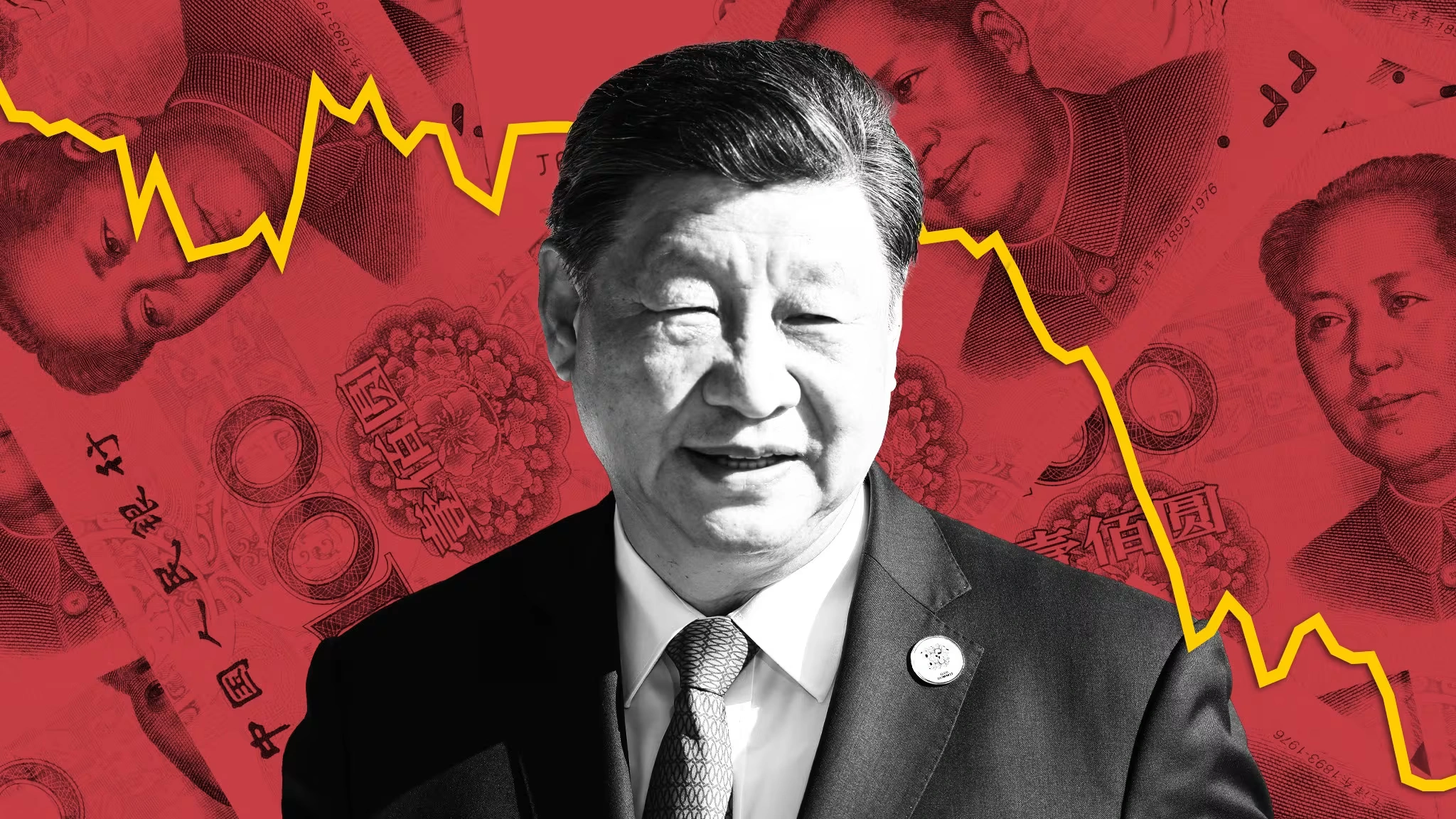
China has now recorded ten consecutive quarters of falling prices. What used to be treated as a domestic Chinese problem is increasingly a global one, as manufacturers flood export markets with discounted goods to move inventory Beijing’s own consumers won’t buy.
The mechanism, as detailed in an analysis by The Tribune, is straightforward but corrosive: as Chinese manufacturers cut prices to clear excess inventory abroad, they compress profit margins for competitors from Southeast Asia to Europe. That dynamic is already visible in Malaysia’s electronics sector and adds a further layer of complexity to chipmakers who must simultaneously navigate Chinese price competition and US export controls.
The Scale of the Property Collapse
At the root of China’s deflationary spiral sits its property market. Existing home prices had fallen 22.5% from their 2021 peak as of April 2026, with new home prices down 13.2% and transaction volumes off a staggering 53.8% over five years, according to National Bureau of Statistics data cited by The Tribune. Ratings agency S&P Global expects the pain to continue, forecasting primary home prices will fall a further 1.5% to 2.5% in 2026, with secondary market prices dropping 4% to 5%.
Eurasia Group’s top-risks analysis, referenced in the same report, likens the household wealth destruction to the scale of the 2008 US housing crash — except still deepening rather than resolving. The analysis argues Beijing “won’t do anything to stop it” in any decisive way, with President Xi Jinping prioritising political control and technological supremacy ahead of the 21st Party Congress in 2027 over the kind of aggressive consumption stimulus that could break the deflationary cycle.
Overcapacity Without Buyers
The strategic choice not to stimulate household demand has produced a predictable side effect: overcapacity. Weak domestic consumption means Chinese factories are producing more than the home market can absorb, and that surplus supply is being pushed into export channels at aggressively low prices. Youth unemployment, meanwhile, reached 16.9% even as headline GDP growth posted 4.5% for 2026 — a divergence between top-line growth figures and the lived economic reality for younger workers that increasingly defines China’s macro narrative, per figures cited by The Tribune.
Analysts are increasingly drawing comparisons to Japan’s “lost decades” — a prolonged period of stagnant prices, weak consumption and a property bust from which the economy took a generation to recover.
The Politburo’s Reform Bet
Beijing’s own signalling suggests officials are aware of the trap but are choosing a slower-acting fix. According to Asia Times, a Politburo meeting made clear that Xi’s administration intends to lean on structural reform rather than another export-led stimulus push, aiming to unlock roughly $22 trillion in Chinese household savings as the real lever for ending deflation.
Societe Generale economist Wei Yao told Bloomberg, as cited in the same report, that benchmark Chinese bond yields could fall to record lows in 2026 as the central bank continues easing monetary policy — a sign that even reform-minded officials expect deflationary pressure to persist for some time yet. The risk, as the analysis notes, is one of “overpromising and underdelivering”: aligning fiscal expansion with structural reform, strengthening household demand without amplifying financial vulnerabilities, and advancing industrial upgrading while preserving market discipline are all simultaneously difficult tasks.
Why Exports Alone Won’t Solve It
China’s export engine has, in isolated periods, looked spectacular. Reuters reported that Chinese exports surged 21.8% year-on-year in the January-February period earlier in the cycle, powered by red-hot electronics and integrated-circuit demand tied to the global AI investment boom, according to Investing.com. But strong export headline numbers coexist with the deflationary spiral precisely because that export strength is partly a symptom of the problem: firms unable to sell at healthy margins domestically are dumping output overseas.
A separate analysis from the Rhodium Group, referenced in coverage of China’s financial and fiscal decay, notes China’s economy has become far more dependent on exports in 2026 than in previous years, even as the country’s own reported investment data shows troubling inconsistencies — including an outright decline in fixed asset investment that some economists argue is not being adequately addressed by policymakers.
The Ripple Effects Beyond China’s Borders
The global transmission channel matters for every market this publication covers:
- Southeast Asia (Malaysia, Indonesia, Singapore) faces direct price competition in electronics and manufactured goods, squeezing margins for domestic producers who cannot match subsidised Chinese export pricing.
- Global rate-setting is complicated as persistent Chinese deflation feeds into the inflation calculus of central banks including the US Federal Reserve, which must weigh imported disinflationary pressure from Chinese goods against domestic price dynamics.
- Commodity and shipping markets absorb volume effects as Chinese export volumes remain elevated even as unit prices fall, distorting freight rates and raw material demand signals.
- Emerging-market manufacturers, including in Pakistan’s textile sector, face indirect competitive pressure as Chinese goods compete on price across overlapping product categories in third markets.
The Bottom Line
China’s deflation is no longer a story that can be analysed purely through the lens of domestic property prices or local consumer sentiment. Ten straight quarters of falling prices, a housing correction that rivals the 2008 US crash in scale, and a policy choice to prioritise long-term structural reform over immediate stimulus mean the deflationary pressure has nowhere to go but outward — into export markets, into global rate-setting decisions, and into the margins of manufacturers from Kuala Lumpur to Katowice. For businesses and policymakers across Asia, Europe and North America, China’s price problem has become everyone’s price problem.


