


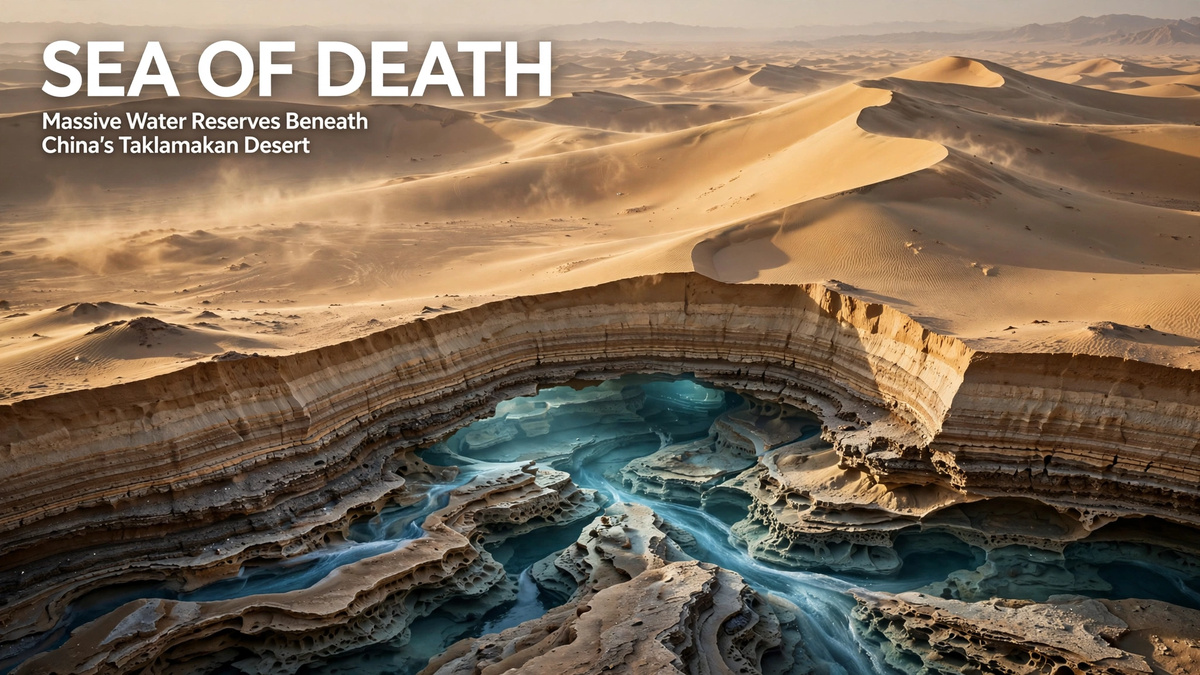
Beneath the shifting sands of the Taklamakan Desert, historically dubbed the “Sea of Death,” lies a life-sustaining secret that could fundamentally alter the ecological and agricultural future of northwestern China. Geologists have recently uncovered two massive groundwater reserves in the Xinjiang Uygur Autonomous Region, a discovery that completely upends previous assumptions about subterranean water systems in hyper-arid environments.
This finding not only challenges the long-held scientific belief that desert groundwater is merely stagnant and saline but also opens unprecedented avenues for sustainable development, ecological restoration, and desert boundary control in southern Xinjiang.
A Groundbreaking Geological Discovery
Led by the Hydrology and Environmental Geology Survey Center of the Xinjiang Geological Bureau, exploration teams located these vast water sources in two distinct areas: near Minfeng County on the desert’s southern edge, and deep within the desert’s hinterland just south of the Mazartag Mountains.
According to a comprehensive report by China Daily, the true significance of this discovery lies in the hydrogeological nature of the water. Instead of being trapped and heavily salinized, the newly found subterranean aquifers contain active, flowing, and renewable water—comprising both fresh and brackish reserves. This definitively shatters the traditional paradigm that the world’s second-largest drifting desert holds only stagnant “dead water.”
The High-Tech Hunt for Desert Groundwater
Uncovering a deep aquifer beneath a 337,600-square-kilometer desert required a sophisticated, multi-layered technological approach. Project head Kang Jian detailed that researchers bypassed singular traditional methods in favor of building a comprehensive 3D hydrogeological model utilizing:
- Satellite Remote Sensing: To map surface anomalies and large-scale geological structures from space.
- Aerial Geophysical Surveys: Scanning the desert topography from the air to identify potential subterranean basins and faults.
- Ground-based Exploration and Drilling: To physically verify the water’s presence, analyze its biochemical makeup, and measure its flow rates.
This combination of advanced surveying allowed the team to construct a precise model of the aquifers, effectively mapping out both the freshwater and saline water distribution deep beneath the dunes.
Implications for Ecological Restoration and Agriculture
What elevates this discovery from a scientific triumph to a socio-economic catalyst is its immediate practical application. As highlighted by the Global Times, the survey team has already established a pilot test station aimed at utilizing this resource responsibly.
The primary objective is not mass extraction for human consumption, but rather developing safe irrigation methods using the brackish water. This provides critical support for the Taklamakan Desert border-locking project. By using the salty desert groundwater for specialized, resilient plant irrigation, Xinjiang has been able to continuously fortify its 3,046-kilometer green sand barrier protection belt, pushing the protective vegetation barrier to an impressive 7,500 meters in width.
The Future of Water Security in Southern Xinjiang
Zhang Lei, director of the survey center, emphasized that the ultimate value of the project transcends merely calculating the volume of the newly found reserves. The core question is whether these resources can sustainably support the long-term socioeconomic development of desert regions without triggering rapid ecological depletion.
For decades, heavy agricultural runoff and diverted rivers have disturbed regional water tables across Xinjiang, as previously analyzed by NASA’s Earth Observatory. By tapping into these renewable subterranean aquifers for ecological restoration, Southern Xinjiang can build a localized, secure water infrastructure. This strategy supports its ambitious “sand control” industries while actively mitigating the devastating effects of continuous desertification.
Major Breakthrough in Finding Southern Xinjiang Desert Water This broadcast features commentary on the geological bureau’s discovery of the aquifers, breaking down how the utilization of brackish water will directly support desert border protection projects and local agricultural development.


