


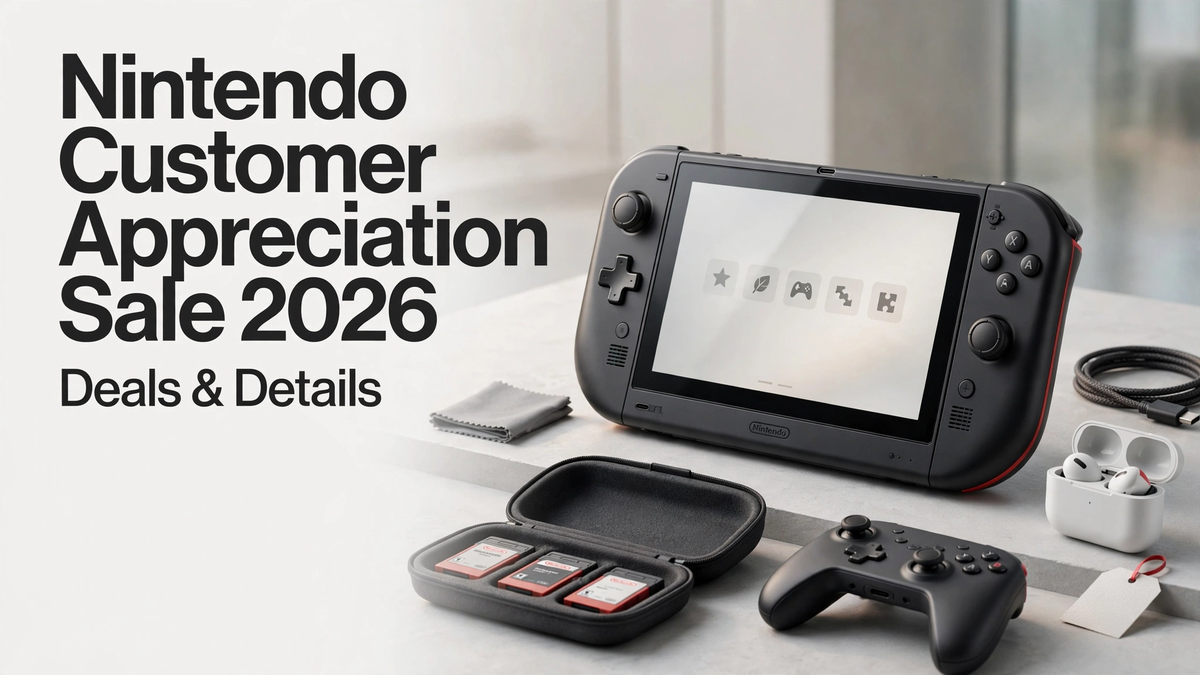
Nintendo just launched what it’s calling one of its largest promotions ever — and unusually for a corporate sale announcement, the company explained exactly where the money is coming from. The Customer Appreciation Sale, running September 13–26, 2026, is funded in part by tariff-related refunds Nintendo received after the U.S. Supreme Court ruled the Trump administration’s import tariffs unlawful. That’s a genuinely unusual piece of corporate transparency, and it makes this sale a useful window into how trade policy whiplash is flowing directly through to consumer prices in real time.
The Sale: What’s Actually Discounted
Nintendo of America’s official announcement confirms the sale runs September 13 through September 26, 2026, across the Nintendo eShop, the Nintendo Store, and participating retailers, offering 30% off dozens of Nintendo Switch digital games and bundles, according to theclick.gg’s coverage of Nintendo’s own notice. Some early press coverage listed a September 12 start date, but Nintendo’s official posting confirms September 13 is the correct date to plan around.
Beyond the headline 30% digital discount, the sale extends to select physical games, downloadable content, accessories, amiibo, and apparel — though the specific discount depth on physical products varies by individual retailer, according to Fox10 News. The promotion applies to games playable on both the original Nintendo Switch and Nintendo Switch 2 systems, but notably does not include any price reduction on Switch or Switch 2 hardware itself, per ThePCEnthusiast’s reporting.
Early confirmed deals (as of sale launch, Sept 13):
| Title | Sale Price | Regular Price |
|---|---|---|
| Super Mario Party Jamboree | $42 | $60 |
| Super Mario Odyssey | $42 | $60 |
| Donkey Kong Country Returns HD | $42 | $60 |
| Luigi’s Mansion 3 + Multiplayer Pack | $49 | — |
According to 9to5Toys’ live coverage, the sale went live with titles starting as low as $7, alongside discounts on amiibo, Nintendo’s Talking Flower collectible, and the Alarmo sound-activated alarm clock — though the retailer noted the promotion is lighter on Switch 2-specific new releases than many shoppers had hoped, with the bulk of the discount depth concentrated in the existing Switch software library.
The Real Story: A Tariff Refund Turned Into a Consumer Discount
What makes this promotion genuinely newsworthy from a business-economics standpoint is Nintendo’s own framing. The company’s announcement states directly that the sale “is made possible in part by tariff-related refunds,” according to This Week in Video Games.
The backstory: in August 2025, following the imposition of tariffs on certain imports by the Trump administration, Nintendo raised U.S. retail prices on several hardware products, including the original Nintendo Switch console, at the time citing only “market conditions” rather than tariffs specifically. The policy reversed in 2026 when the Supreme Court ruled that the Trump administration’s import tariffs had been imposed unlawfully. Nintendo was among the companies that applied for and received a tariff refund from the U.S. government as a result.
That refund shows up directly in Nintendo’s own financial disclosures. In its Q1 FY2027 results (covering April 1 to June 30, 2026), Nintendo reported operating profit that beat its own forecast, a result the company attributed partly to strong game sales and partly to the tariff refund itself, according to This Week in Video Games.
Why the Timing and Framing Matter
Running a sale explicitly tied to a tariff-refund windfall serves multiple business functions at once. According to analysis from Shattered.io, the announcement lands at what it describes as “an awkward moment” for Nintendo: Switch 2 hardware pricing had just climbed in the U.S., the console’s year-on-year unit growth has cooled from its 2025 launch highs, and Nintendo lacks a new flagship console to sell through the back half of 2026. Framed that way, the sale functions simultaneously as:
- Goodwill positioning: explicitly connecting the discount to a tariff refund frames Nintendo as passing savings back to customers rather than simply running a routine seasonal promotion
- Software-driven revenue defense: with no new hardware launch to drive holiday-quarter sales, discounting the existing software library is the lever available to sustain engagement and spending across two simultaneous console generations (original Switch and Switch 2)
- Consumer-legal context management: the explicit tariff framing arrives at a moment when Nintendo’s handling of tariff-related hardware price increases has already drawn legal and consumer scrutiny, according to Techgenyz’s coverage
What Shoppers Should Actually Do
Nintendo’s own announcement, as of publication, does not name the complete list of discounted titles or exact sale prices for every product category — reporters and deal trackers have been building the list in real time as the sale went live. Practical guidance for shoppers:
Shopping checklist for the sale window (Sept 13–26):
- Compare prices across the Nintendo eShop, Nintendo Store, and any participating third-party retailer, since multiple outlets confirm discount depth and selection vary by channel
- Don’t expect hardware discounts — the 30% headline figure applies to software, DLC, accessories, amiibo, and apparel, not Switch or Switch 2 consoles
- For Switch 2 bundle purchases specifically, confirm whether a given retailer’s deal includes hardware at all, since Nintendo’s own language focuses on software and accessories
- Check both current-gen Switch and Switch 2 listings, since the promotion spans titles compatible with either system
Final Verdict
The Nintendo Customer Appreciation Sale is worth attention for two separate reasons: as a genuinely large software discount event during a fall stretch when Nintendo has no new console to sell, and as one of the clearest real-world examples yet of a 2025 tariff policy reversal flowing directly through to a specific, dated consumer promotion. For shoppers, the calculus is straightforward — strong value on existing Switch and Switch 2 software libraries, DLC, and accessories, but no help on hardware pricing. For anyone tracking the broader economic story, Nintendo’s willingness to explicitly cite its tariff refund as a funding source for the sale is a rare piece of corporate transparency connecting trade policy directly to a specific consumer-facing price action, and it’s worth watching whether other import-dependent consumer electronics companies follow with similar tariff-refund-funded promotions of their own.


