


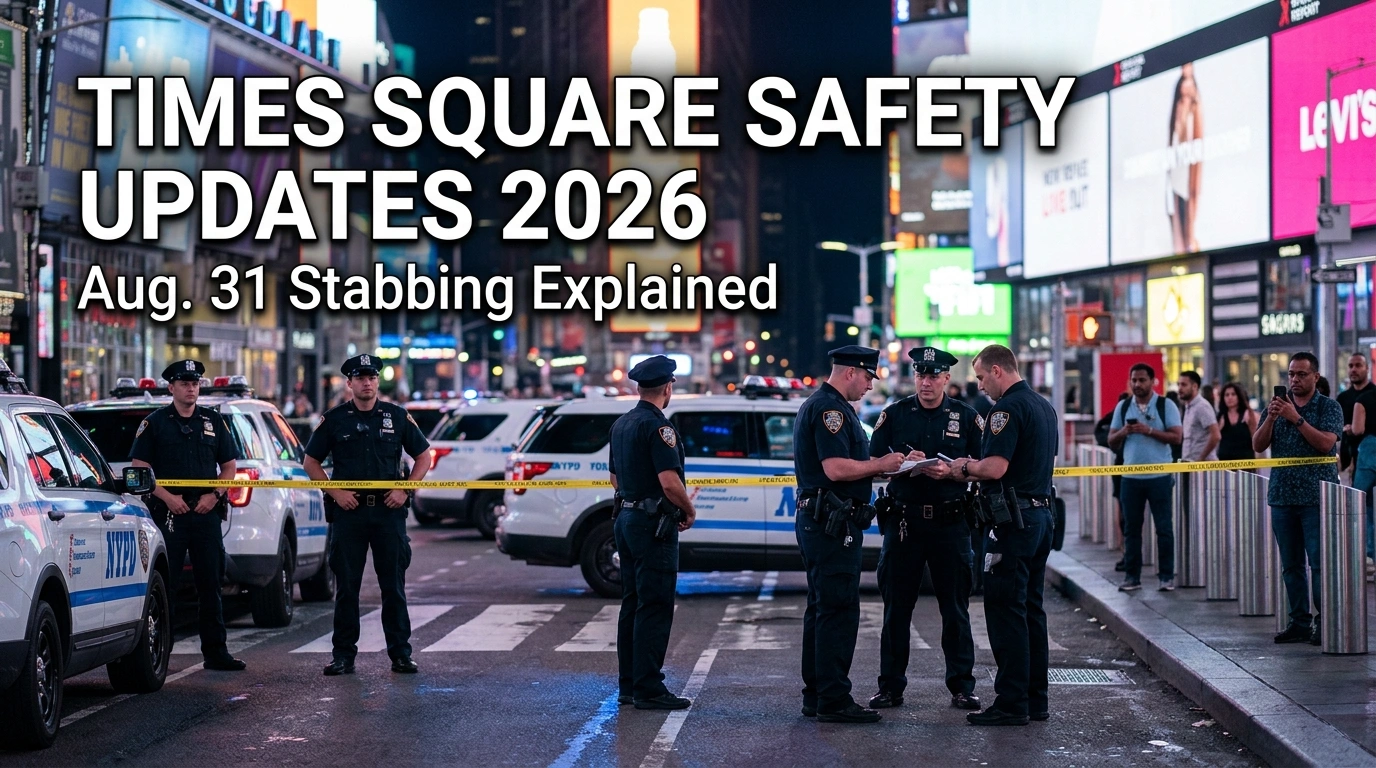
A woman armed with two knives stabbed two people in Times Square on August 31, 2026 — killing a 32-year-old bystander and critically wounding a 68-year-old man — before NYPD officers fatally shot her after a four-minute standoff, a violent incident that unfolded even as citywide homicides are down 24% and on pace for one of the lowest totals in decades, underscoring a split reality in New York’s most heavily policed tourist district.
What Happened on August 31
According to NYPD Commissioner Jessica Tisch, the attacker — identified as 49-year-old Pamela Cisneros of Queens, who has a documented mental health history with the department — pulled two large knives from a shopping bag near a police substation just outside One Times Square, the building famous for hosting the city’s annual New Year’s Eve ball drop. Cisneros stabbed a 68-year-old man in the abdomen as he stepped out of the subway and waited to cross the street with his wife. Within roughly 20 seconds, she then stabbed a 32-year-old woman, also in the abdomen.
Officers engaged with Cisneros for approximately four minutes, giving what Tisch described as “numerous commands to drop the knives,” which she refused. Police ultimately shot and killed her. The 32-year-old woman was pronounced dead at the hospital; the 68-year-old man survived and was listed in stable condition. Mayor Zohran Mamdani confirmed all parties were transported to Bellevue Hospital and announced an internal investigation, with body camera footage expected to be released to the public in due course. Tisch defended the officers’ response, stating: “Our officers did exactly what they’re trained to do, and that is to protect themselves when a perpetrator… is coming at them armed with and waving two knives.”

The NYPD closed part of 7th Avenue and warned the public to stay away from the immediate area during the response, which unfolded in one of the busiest pedestrian corridors in the world — a location Tisch noted was, at the time, surrounded by “thousands of commuters, families and tourists.”
The Second Times Square Killing of 2026
This marks the second fatal incident in Times Square so far in 2026; a man was fatally stabbed in the same general area in May. The recurrence in one of the most heavily surveilled and patrolled locations in New York City has reignited public debate over whether current safety measures — dense police presence, extensive camera coverage, and rapid response infrastructure — are adequate against random, unpredictable attacks carried out in a matter of seconds.
A Wider Pattern: Subway-Adjacent Violence Near Times Square
The August 31 stabbing was not an isolated data point for the district. Just one week earlier, on August 24, an MTA cleaner was stabbed in the arm at the Times Square-42nd Street subway platform after confronting a man for public urination; the attacker escaped on a southbound 1 train. Separately, NYPD was searching for a suspect in a groping investigation reported at the same platform complex around the same period, and in a related incident, a 35-year-old man was stabbed in the head at the Times Square-42nd Street station following a dispute that turned violent.
Further up the same transit corridor, the Grand Central-42nd Street subway station saw an even deadlier confrontation in April 2026, when police fatally shot a suspect armed with a machete after he randomly slashed three commuters — a shooting that subsequently prompted lawsuits from victims alleging officers were not present when the attack began.
The Data Behind the Headlines: Concentrated Risk in High-Volume Stations
Research from the nonpartisan organization Vital City offers useful context for interpreting this cluster of incidents. While overall homicides and property crimes fell citywide through mid-2026, felony assaults in the subway system have followed a different trajectory, and the organization’s analysis found that half of all violent transit crimes across the city’s 472 subway stations are concentrated in just 30 high-volume stations — a category that explicitly includes the Times Square complex. In other words, Times Square’s outsized share of violent transit incidents is not purely a matter of perception; it reflects genuine statistical concentration tied to the sheer foot traffic and transit density of the area.
What NYC Has Already Invested in Response
State and city officials have not been passive on this front. Governor Kathy Hochul committed $77 million in state funding in December 2025 specifically to maintain enhanced NYPD subway platform patrols and expand mental health outreach teams through 2026 — an extension of joint city-state safety measures first established in 2022. New York also expanded felony-level assault protections that year to cover a broader range of transit-adjacent violent conduct.
Citywide Context: A Genuine Decline in Violent Crime
It’s important to place these high-profile Times Square incidents against the backdrop of the city’s overall crime trajectory. Citywide homicides are down 24% year-over-year as of the most recent reporting, putting New York on pace for potentially its lowest homicide total in decades. This citywide decline stands in tension with the recurring, high-visibility nature of Times Square incidents specifically — a reminder that aggregate crime statistics and localized, high-traffic-area risk can move in different directions simultaneously.
| Metric | Trend | Source Context |
|---|---|---|
| Citywide homicides | Down 24% year-over-year | On pace for one of the lowest totals in decades |
| Times Square fatal incidents in 2026 | 2 (May and August) | Both involved bladed weapons |
| Subway violent crime concentration | 50% of incidents in 30 of 472 stations | Times Square complex included in that high-risk group |
| State funding for subway safety | $77 million (Dec. 2025 commitment) | Funds enhanced patrols and mental health outreach through 2026 |
Practical Safety Guidance for Visitors and Commuters
For tourists and commuters navigating Times Square and its surrounding transit hubs, safety commentators and crime-prevention advocates emphasize a few consistent, practical points rather than broad avoidance of the area: situational awareness in dense crowd conditions matters more than any specific security infrastructure, since attacks of this nature unfold in seconds and are, by their nature, difficult to prevent even with heavy police presence nearby. As one crime-prevention advocate has put it regarding the area’s overall safety record, “the reality is tens of thousands of people go through Times Square every day, every night and go through safely and without any incident at all” — a statistical reality that coexists with the disproportionate media and public attention any single violent incident in the district inevitably attracts.
Key Takeaways
- A woman fatally stabbed one person and critically wounded another in Times Square on August 31, 2026, before being shot and killed by NYPD officers.
- This was the second fatal Times Square incident of 2026, following a fatal stabbing in the same area in May.
- Research shows half of all violent transit crimes citywide are concentrated in just 30 of New York’s 472 subway stations, including the Times Square complex.
- Citywide homicides are down 24% year-over-year even as Times Square has experienced a cluster of violent, high-profile incidents in 2026.
- New York State committed $77 million in December 2025 to fund enhanced subway patrols and mental health outreach through 2026.
Frequently Asked Questions
Is Times Square safe to visit in 2026?
Overall citywide violent crime, including homicides, is down significantly in 2026, and Times Square remains one of the most heavily policed areas in New York City — but it has experienced two fatal incidents this year, reflecting a broader pattern of concentrated transit-adjacent violence in high-traffic areas.
What happened in the August 31 Times Square stabbing?
A 49-year-old woman with a documented mental health history stabbed two people with knives near One Times Square; one victim died and the other survived. Police fatally shot the attacker after a four-minute standoff.
Why does Times Square see recurring violent incidents despite falling citywide crime?
Research indicates that violent transit crime is disproportionately concentrated in a small number of high-volume subway stations, including the Times Square complex, due to the area’s exceptionally high foot traffic.


