


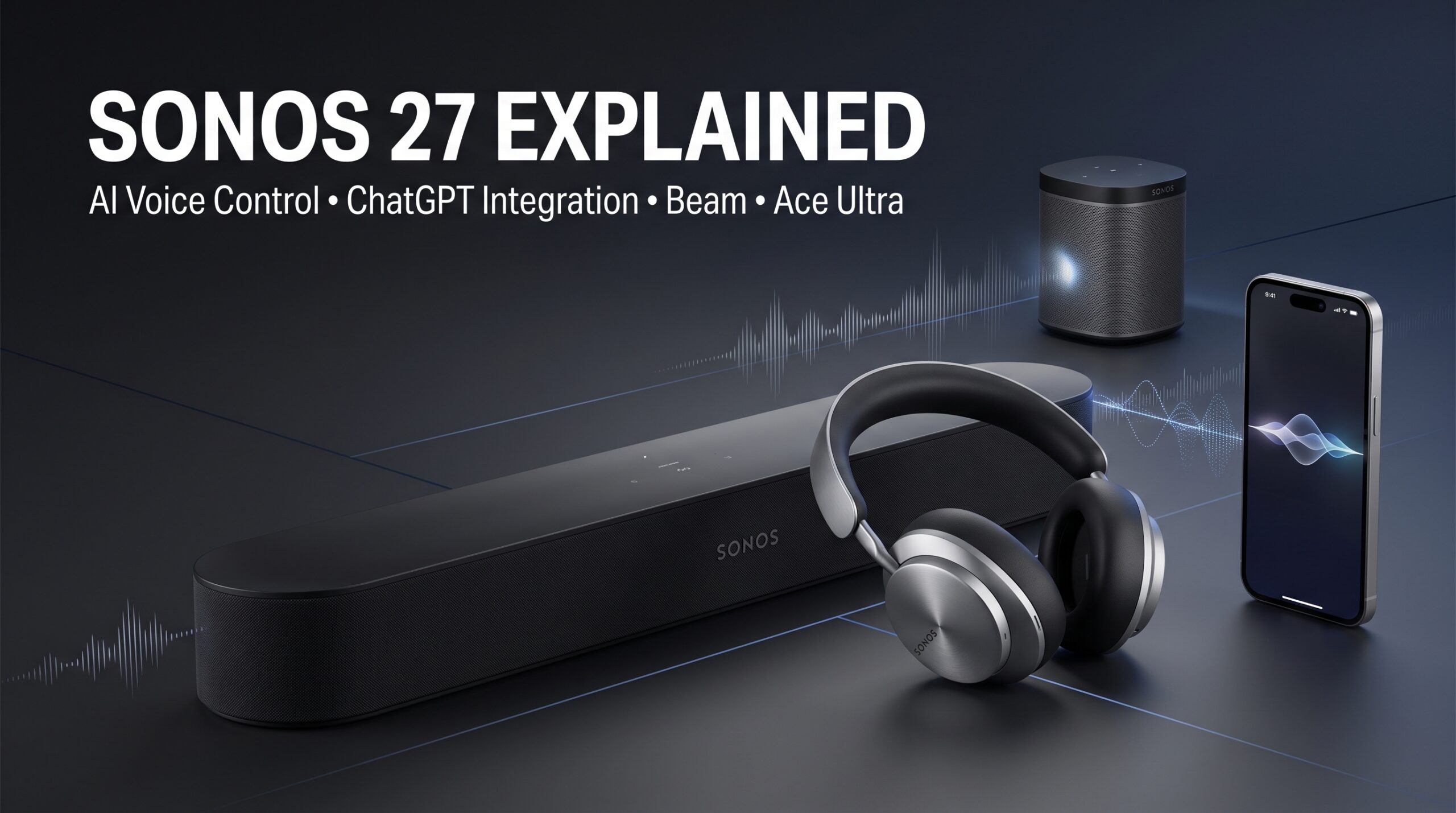
Sonos unveiled Sonos 27, a renamed and AI-expanded version of its existing audio platform, alongside two new flagship products: the $699 Beam Ultra soundbar and $449 Sonos Ace Ultra headphones. The headline change is Sonos opening its ecosystem to outside AI assistants — including ChatGPT — through a new framework called Sonos 27mcp, while adding its own in-house Sonos 27voice assistant, with the broader software update rolling out to existing S2-compatible products starting September 8, 2026.
Sonos 27 Launch: Products, Pricing & Rollout Timeline
| Product/Feature | Price | Availability | Key Detail |
|---|---|---|---|
| Sonos Beam Ultra (soundbar) | $699 | Pre-order now; ships Sept. 29, 2026 | 9-driver, true 7.1.2 Dolby Atmos, 4 levels of AI Speech Enhancement |
| Sonos Ace Ultra (headphones) | $449 (same as original Ace) | Pre-order now; ships Sept. 29, 2026 | New 40mm Sonos-designed driver, 10-mic adaptive ANC, Headphone Engine 2 |
| Ace Ultra battery life (ANC on) | Up to 35 hours | — | 5 hours more than original Ace |
| Sonos 27voice (in-house AI assistant) | Free software update | Early access, later fall 2026 | English (US) only at launch; existing Sonos Voice Control remains available |
| Sonos 27mcp (external AI connector) | Free software update | Early access begins Sept. 8, 2026 | Connects ChatGPT and any MCP-compatible AI model/agent |
| Sonos Custom Agents | Preview/future feature | Not yet available | Lets users build agents with chosen model, persona, and voice |
| Sonos Fabric (headphone linking, portable surrounds) | Free software update | Headphone linking: Sept. 29; portable surrounds: Sept. 8 | Auto-detects speaker position/role via Sonos Positioning Technology |
| Redesigned app navigation | Free software update | Sept. 8, 2026 | Persistent home/system/search tabs, pinned favorites |
| Amp Multi (professional multizone amplifier) | Integrator/custom-install channel | Already shipping | Aimed at custom integrators, not direct consumers |
Sources: Sonos official announcement via CEPRO, AppleInsider, Trusted Reviews, HowToGeek, Neowin, Engadget, and RedShark News — all Sept. 1–2, 2026, corroborating the CEDIA Expo and Open House event reveals.
Deep Dive: What’s Actually New, and Why Sonos Chose an Open AI Strategy
The Name Change Signals a Platform Shift, Not Just a Version Bump
It’s worth being precise about what “Sonos 27” actually is: rather than a wholesale replacement of the existing S2 software platform, Sonos is rebranding and extending its current audio operating system, giving it a version-style name to make the company’s ongoing capability additions easier for consumers to track and understand. This matters for existing owners — Sonos 27 arrives as a software update to products already running the S2 app and system, meaning most of the software-side features (redesigned navigation, AI voice control, MCP connectivity) extend to previously purchased hardware rather than requiring a new device purchase, with headphone linking specifically reserved for Ace Ultra given its new hardware requirements.
The Multi-Assistant Bet: Why Sonos Isn’t Building One Closed Voice Assistant
The most consequential strategic decision inside Sonos 27 is the choice to open the platform to outside AI providers rather than building a single proprietary voice assistant to compete head-on with Alexa, Google Assistant, or Siri. Sonos 27mcp — built on the Model Context Protocol standard — lets external AI assistants and agents, explicitly including OpenAI’s ChatGPT, connect directly to a user’s Sonos system and control it. Because MCP is an open standard, any large language model capable of using an MCP server can potentially control a Sonos system after proper authorization, not just ChatGPT specifically, even though ChatGPT is the flagship partner called out in Sonos’s own announcement materials.
This is a materially different strategy from Sonos’s own history: the company’s own in-house assistant, Sonos 27voice, focuses specifically on music discovery and mood-based curation — a narrower, more specialized use case — while explicitly continuing to support the older Sonos Voice Control system alongside the new option rather than forcing an immediate replacement. The practical effect for consumers: rather than being locked into whichever AI assistant a speaker manufacturer chooses, Sonos owners can theoretically direct whatever AI assistant they already use elsewhere (in a browser, on their phone) to also control their home audio system.
Sonos Fabric: The Under-the-Radar Feature With the Most Practical Utility
While the AI integration is generating the most headlines, Sonos Fabric may prove to be the more immediately useful addition for everyday users. Built on Sonos Positioning Technology — which uses high-frequency sound to detect where speakers are physically located relative to each other — Fabric allows compatible portable speakers (such as the Move 2 or Play line) to automatically reconfigure into rear surround-sound roles the moment they’re moved into the right position relative to a compatible soundbar like the Beam Ultra. In practical terms, this means a portable speaker used outdoors for a party could be brought inside and automatically become part of a home theater surround setup without manual reconfiguration — a meaningfully different experience from the manual pairing process surround-sound setups have traditionally required.
Hardware Specifics: What’s Actually New in Beam Ultra and Ace Ultra
The Beam Ultra represents a genuine upgrade over prior mid-size Sonos soundbars, adding nine total drivers including two up-firing units to deliver true 7.1.2-channel Dolby Atmos — a higher channel count than Sonos has previously offered in this soundbar tier — alongside a redesigned center channel Sonos describes as producing cleaner dialogue and “warmer” bass, plus four levels of AI-assisted speech enhancement and a dedicated night-sound mode for volume-sensitive late viewing.
The Ace Ultra headphones carry forward the original Ace’s $449 price point while adding a new Sonos-designed 40mm driver and adaptive active noise cancellation powered by 10 microphones — a meaningful jump in mic count for ANC processing. Battery life improves to up to 35 hours with ANC enabled, five hours longer than the original model. The headline new capability, though, is headphone linking via “Headphone Engine 2” hardware: pressing and holding the Ace Ultra’s Content Key transfers audio playback from a nearby compatible Sonos speaker directly to the headphones, and holding it again sends playback back to the speaker — working over a direct connection to the Sonos system rather than requiring the phone to remain in range, provided at least one compatible Sonos product stays connected to the broader system.
Reading the Timing: A Comeback Narrative After a Rocky App Redesign
Some coverage of this launch has explicitly framed it as an attempt at reputational recovery, a reference to Sonos’s widely-criticized 2024 app redesign that frustrated existing customers with removed features and navigation problems. The new app navigation shipping with Sonos 27 — featuring persistent home, system, and search tabs plus the ability to pin favorite speakers — has already been rolling out in limited testing over the summer of 2026 ahead of becoming the default experience on September 8. Given that history, existing Sonos owners upgrading to Sonos 27 have reasonable grounds for some caution about a major navigation change, even as the underlying feature additions (AI connectivity, Fabric, Ace Ultra linking) represent genuine capability expansion rather than a repeat of the prior redesign’s feature removals.
Actionable Takeaways for Consumers
- Existing Sonos owners get most of Sonos 27’s software features for free. If you already own S2-compatible hardware, you don’t need to buy Beam Ultra or Ace Ultra to get the AI voice control, MCP connectivity, and redesigned navigation — those arrive as a standard software update starting September 8.
- Wait for Sonos 27voice’s broader language rollout if you don’t speak English. The in-house assistant launches in English (US) only at first, with no confirmed timeline yet for additional languages.
- Confirm your existing speakers support Sonos Fabric’s automatic surround detection before assuming it will work out of the box. The portable-surround feature specifically requires compatible Move 2 or Play-series speakers paired with a compatible soundbar.
- Factor in the USB camera requirement if you’re interested in CameraPlay-style features (relevant to the broader Sonos ecosystem context), and note headphone linking requires the new Ace Ultra hardware specifically — the original Ace headphones do not support the Headphone Engine 2 linking feature.
- If you’re mid-decision between the original Ace and Ace Ultra, weigh the $0 price difference against the real upgrades. Ace Ultra ships at the same $449 price as the original Ace, meaning the added driver, extra microphones, longer battery life, and headphone linking come with no listed price premium — a meaningfully different value proposition than a typical “Ultra” tier upsell.
Frequently Asked Questions
What is Sonos 27 and is it a new operating system?
Sonos 27 is a rebranded and expanded version of Sonos’s existing audio software platform (previously known simply as the S2 app and system) rather than an entirely new operating system, adding AI voice control, external AI assistant connectivity, and a redesigned app alongside two new hardware products.
Can I use ChatGPT to control my Sonos speakers?
Yes — Sonos 27mcp, rolling out in early access starting September 8, 2026, lets external AI assistants and agents, including ChatGPT and other MCP-compatible AI models, connect directly to a Sonos system and control playback and settings.
How much do the Sonos Beam Ultra and Ace Ultra cost?
The Sonos Beam Ultra soundbar is priced at $699 and the Sonos Ace Ultra headphones at $449 — the same price as the original Ace — with both available for pre-order now and general availability beginning September 29, 2026.
Do I need to buy new hardware to get Sonos 27’s AI features?
No — most Sonos 27 software features, including AI voice control, external AI assistant connectivity (Sonos 27mcp), and the redesigned app navigation, roll out as a free update to existing S2-compatible Sonos products; only headphone linking is exclusive to the new Ace Ultra hardware.


