


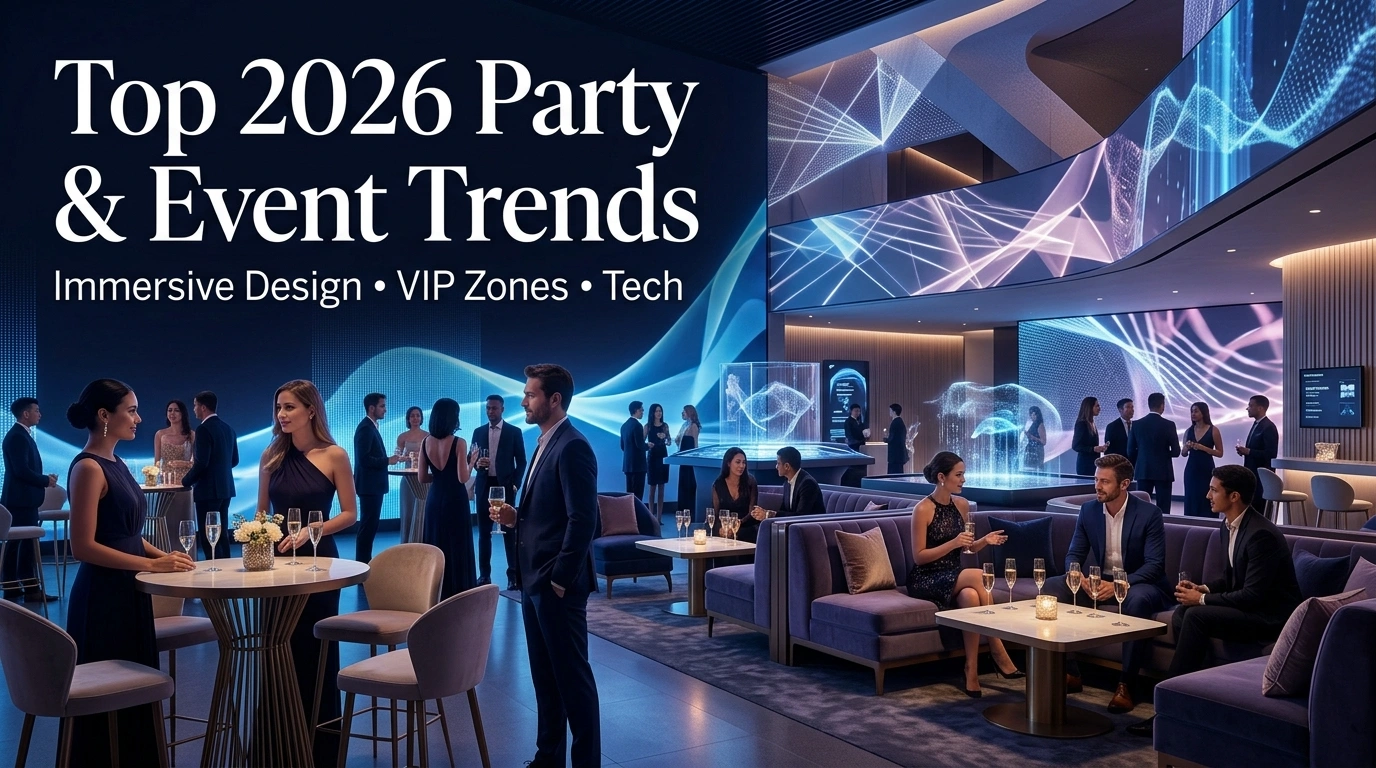
Event planning in 2026 has shifted decisively from decor-as-backdrop toward fully immersive, story-driven environments — think jungle-rainforest and sci-fi themed galas, foliage-maze guest entrances, and holographic performer overlays — while the industry itself continues expanding, with the global event marketing sector projected to reach $36.31 billion and 86.4% of organizers planning to maintain or increase in-person events. The through-line across virtually every trend report for the year: guests now expect active participation and sensory immersion rather than passive attendance, from arrival to final dance.
2026 Event Planning Trends at a Glance
| Trend Category | Specific 2026 Manifestation |
|---|---|
| Immersive themes | Jungle-rainforest, sci-fi/futuristic, festival-inspired, “dream circus” concepts |
| Entrance experience design | Foliage mazes and greenery tunnels transforming arrival into a discovery moment |
| Emerging luxury entertainment tech | Holographic performer overlays, AI-generated personalized event experiences |
| Viral/novel entertainment | Illuminated “butterfly drones,” AR-blended brand experiences, projection mapping on tables/walls/stages |
| Guest engagement format | Gamified experiences, themed lounges, interactive photo installations, creative workshops |
| Dining/catering direction | Communal dining formats, zero-proof cocktails, wellness-inspired menus |
| Gathering size trend | Shift toward smaller, more curated, intimate gatherings alongside large-scale events |
| Celebration format | Destination milestone celebrations spanning a full weekend |
| VIP-specific design | Dedicated VIP zones for sponsors, executives, or performers offering exclusivity and elevated comfort |
| Sustainability angle | Reusable/faux foliage installations, sustainable scenic materials |
| Live entertainment preference | Live bands remain top-rated for high-end events over pre-recorded or playlist-based options |
| Industry growth (event marketing) | Projected to reach $36.31 billion in 2026 (Daedal Research) |
| Organizer intent | 86.4% plan to maintain or increase in-person events |
Sources: The Bash’s 2026 party trends roundup (event professionals survey), Live Nation Special Events, Eventologists, Uptown Drive/Daedal Research industry data, ednovi.com.mx, Boom Photo Booth, and Bright Light Events — all published Dec. 2025–Aug. 2026.
Deep Dive: Reading the Trends Beneath the Trend List
The Common Thread: Décor Has Been Replaced by Narrative Design
Multiple independent industry sources converge on a single underlying shift that the individual trend items (foliage mazes, holographic overlays, themed lounges) are really just expressions of: event design in 2026 has moved from treating decor as a static backdrop toward treating the entire physical environment as a storytelling mechanism. One event professional captured this explicitly, noting that “texture, lighting, seating flows, interactive details all combine to tell a story” rather than functioning as separate, disconnected design elements — meaning a genuinely well-executed 2026-style event needs its lighting design, its entrance sequence, its seating layout, and its entertainment booking to reinforce a single cohesive concept rather than being selected independently. This has direct planning implications: rather than budgeting for “decor” and “entertainment” as separate line items with separate vendors making independent creative decisions, the more effective 2026 approach treats theme, environment, and entertainment as a single integrated design brief from the outset.
Why Guest Arrival Has Become a Deliberate Design Moment, Not an Afterthought
The rise of foliage mazes, greenery tunnels, and similarly designed entrance sequences reflects a specific strategic insight repeated across multiple industry sources: guests form their emotional read on an event’s tone within seconds of arrival, and that first impression carries through the rest of the evening. Rather than treating the entrance as simply the functional path from parking or drop-off to the main event space, 2026’s approach treats it as the first act of the event’s narrative — using layered greenery, textured materials, and atmospheric lighting to build anticipation before guests even reach the primary venue. This is a lower-cost, high-impact design lever relative to headline entertainment bookings: an entrance experience can meaningfully shape guest perception of an entire event’s production value at a fraction of the cost of, say, a major live performance booking.
Technology Entertainment: Distinguishing Genuine Innovation From Novelty
Several 2026-specific entertainment technologies are worth evaluating on their actual guest-engagement merits rather than novelty value alone. Holographic performer overlays and AI-generated personalized event experiences represent genuinely new capability — allowing, for instance, a personalized visual or narrative element unique to each guest or table, a meaningfully different guest experience than a shared, one-size-fits-all entertainment booking. Illuminated “butterfly drones” and augmented-reality brand experiences occupy a middle ground: visually striking and shareable (a meaningful consideration given social media’s role in event perception and word-of-mouth), but requiring careful integration with the broader theme to avoid feeling like an isolated novelty act rather than a coherent part of the evening’s design. Projection mapping — layering video content across tables, walls, and stages — has moved from an occasional gala centerpiece to a broadly available technique suitable for corporate events, conventions, and private VIP celebrations alike, reflecting both falling technology costs and growing planner familiarity with the medium.
The Counterintuitive Rise of Smaller, More Curated Gatherings
Alongside the headline-grabbing immersive, technology-driven large events, industry sources also flag a countervailing trend worth taking seriously: a genuine shift toward smaller, more intimate gatherings that allow for a level of personalization simply not achievable at scale. This isn’t a contradiction of the immersive-experience trend so much as its application at a different scale — smaller guest counts allow hosts to implement genuinely personalized touches (specific dietary accommodations built into a communal dining concept, individually curated welcome gifts, tailored seating arrangements around specific relationships) that would be cost-prohibitive or logistically impossible at a 300-person gala. Planners working across both scales should recognize that “immersive” and “personalized” are not synonymous with “large” — the same underlying philosophy of guest-experience-first design applies whether the guest count is 30 or 300, just executed through different specific tactics.
VIP Zone Design as a Distinct Discipline From General Event Design
VIP areas — whether for sponsors, executives, or performers — represent a design challenge distinct from general event space, and 2026’s approach treats them accordingly rather than simply cordoning off a nicer section of the same room. Effective VIP zone design in current practice emphasizes genuine exclusivity and comfort differentiation (distinct furniture, service level, and sometimes an entirely separate thematic sub-experience within the broader event) rather than a merely roped-off subsection of identical space — the goal is to make VIP status feel like a qualitatively different experience, not just a quantitatively better seat.
Wellness and Sustainability as Mainstream Planning Considerations, Not Niche Add-Ons
Zero-proof cocktails, wellness-inspired menus, and sustainable scenic materials (including reusable faux foliage) have moved from niche accommodation categories into default planning considerations across multiple 2026 trend reports. This reflects broader shifts in guest expectations beyond the events industry specifically — planners increasingly need to build these considerations into initial event concepts rather than treating them as special-request accommodations layered on afterward, since a meaningful share of any given guest list is now likely to actively seek out non-alcoholic options or health-conscious menu choices as a baseline expectation rather than an exception.
Why Live Entertainment Retains Its Premium Position Despite Technology Advances
Despite the proliferation of new entertainment technology — holographic overlays, AR experiences, drone displays — live bands remain the top-rated entertainment choice specifically for high-end events, according to industry sourcing, on the strength of the real-time crowd energy and adaptability a live performance provides that no pre-recorded set or technology-driven display can fully replicate. This is a useful data point for planners weighing budget allocation between cutting-edge technology entertainment and more traditional live performance bookings: the data suggests these are complementary investments serving different functions (technology for visual spectacle and shareability, live performance for sustained crowd energy and emotional connection) rather than substitutes for one another.
Actionable Takeaways for Event Planners and Hosts
- Design theme, entrance, lighting, and entertainment as a single integrated brief, not separate vendor decisions. Brief every vendor — decor, entertainment, catering, lighting — against the same narrative concept from the outset rather than selecting each independently and hoping they cohere.
- Invest in entrance-sequence design even on a moderate budget. A well-designed arrival experience delivers outsized perceived production value relative to its cost compared to headline entertainment bookings.
- Match your technology entertainment choice to your actual guest-engagement goal. Use personalized technology (holographic overlays, AI-generated elements) when individual guest experience matters most; use visually shareable technology (drone displays, projection mapping) when social-media-driven buzz is the primary goal.
- Don’t assume immersive, personalized design requires a large guest count or big budget. Apply the same guest-experience-first philosophy at smaller scale through different tactics — curated details are often more achievable, not less, with a smaller guest list.
- Build wellness and sustainability considerations into your initial concept, not as after-the-fact accommodations. Include zero-proof options and dietary-conscious menu design in your first planning conversation with caterers, rather than treating them as special requests to handle separately.
Frequently Asked Questions
What are the biggest party and event trends for 2026?
The dominant trends for 2026 center on fully immersive, narrative-driven event design — including themed environments like jungle-rainforest and sci-fi concepts, foliage-maze entrances, holographic entertainment technology, and gamified guest engagement — alongside a parallel rise in smaller, more curated intimate gatherings.
How big is the event planning industry in 2026?
According to Daedal Research, the global event marketing industry is projected to reach $36.31 billion in 2026, with 86.4% of event organizers planning to maintain or increase their in-person event activity.
What entertainment technology is trending at events in 2026?
Emerging luxury entertainment formats for 2026 include holographic performer overlays, AI-generated personalized event experiences, illuminated “butterfly drones,” augmented reality brand experiences, and projection mapping across tables, walls, and stages.
Are smaller events replacing large galas as the dominant 2026 event trend?
No — smaller, more curated gatherings are trending alongside large-scale immersive events rather than replacing them, reflecting the same underlying guest-experience-first design philosophy applied at different scales rather than a wholesale shift away from larger events.


